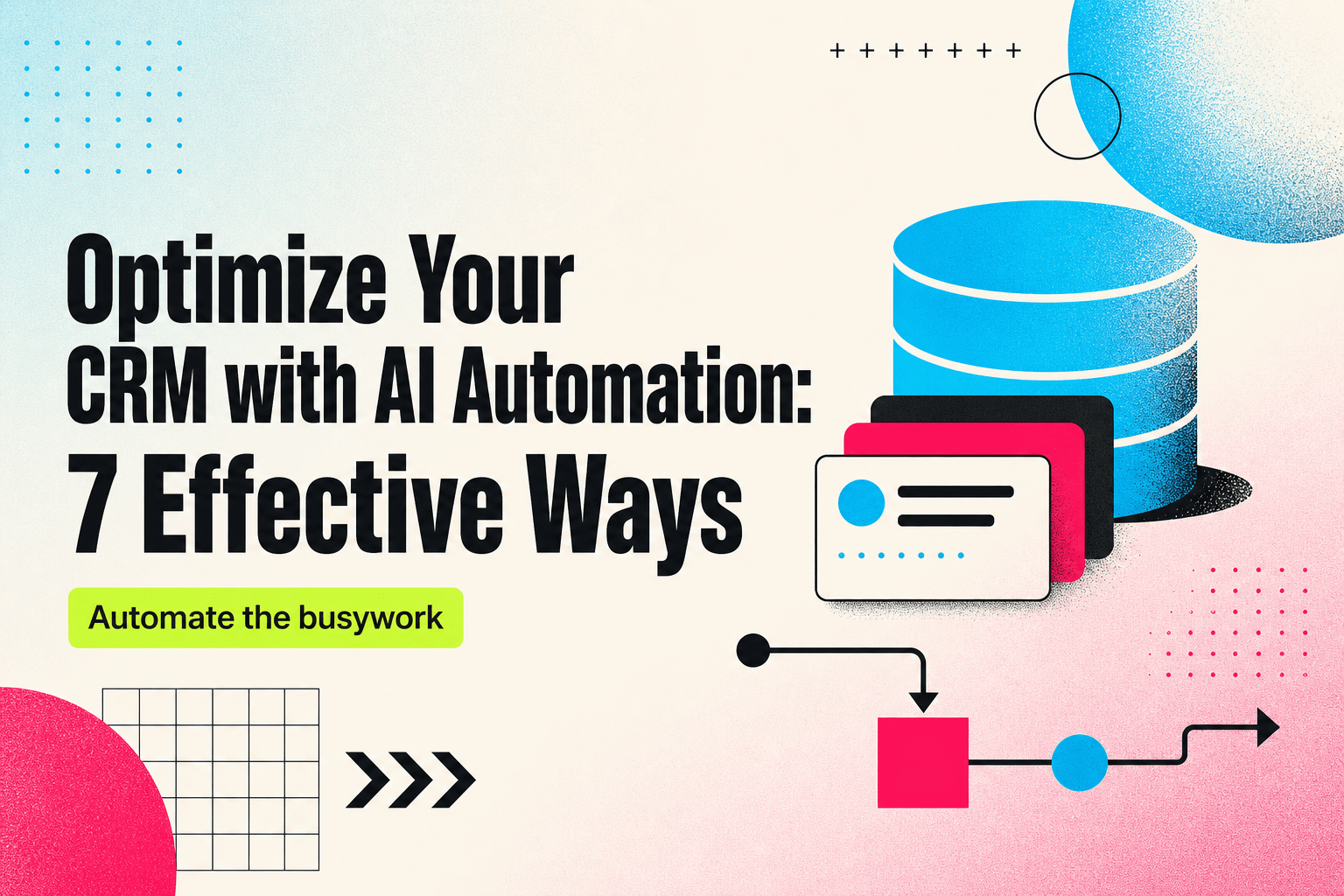
Optimize Your CRM with AI Automation: 7 Effective Ways
CRM systems are supposed to make customer relationships easier to manage. In practice, many teams end up fighting the system instead. Reps waste time updating records, follow-up tasks get missed, lead quality is inconsistent, and useful customer data ends up scattered across inboxes, forms, chats, and spreadsheets. That’s where AI Automation starts to matter.
A well-optimized CRM doesn’t just store contacts. It helps your team act faster, prioritize better, and keep customer conversations moving without adding more manual work. Recent industry data suggests most marketing teams already lean on automation for reporting and analysis, and a large majority of salespeople see the CRM as a real bridge between sales and marketing (HubSpot marketing statistics). Even so, fragmented data remains a common headache for growing companies. Improvement is usually less about swapping platforms and more about building reliable workflows around the system you already have.
If you run a small business, agency, real estate team, or operations-heavy company, you don’t need a massive rebuild to get results. Start with practical workflows that reduce admin work, improve lead qualification, and create more consistent customer communication. These seven strategies are a strong place to begin.
1. Automate Data Entry
Manual CRM updates are one of the fastest ways to create bad data. Someone forgets to log a call, copies the wrong email address, or leaves key fields blank because they’re rushing to the next task. Over time, that turns your CRM into a half-finished record of what happened instead of a reliable operating system.
AI can fix a lot of this by capturing data automatically from web forms, chat conversations, email threads, call notes, and calendar activity. Instead of asking your team to fill in every field by hand, use Workflow Automation to create records, enrich contact details, tag lead sources, and organize interactions as they happen. For a deeper look at research and enrichment before reps open a record, see how to automatically research leads using AI agents.
A practical example: when a prospect submits a contact form, an AI-powered workflow can create the lead, pull company details, assign the correct pipeline stage, and route the record to the right rep instantly.
Practical takeaway: Start with your highest-volume intake points: forms, inboxes, and chat. If your team touches the same data more than once, automate it.
2. Enhance Lead Scoring
Not every lead deserves the same level of attention, but many teams still treat them that way. That slows response times for strong opportunities and wastes time on low-fit prospects who were never likely to convert.
AI-based lead scoring improves this by looking at patterns in behavior, page visits, email engagement, form submissions, firmographic data, deal history, and buying signals, then turning that into a prioritized score. Growth-stage teams that invest in AI for go-to-market work often report the biggest wins in enrichment, cleaner records, and scoring that actually drives routing decisions.
For a small business, this can stay simple. You don’t need an overly complex model. If a lead visits pricing pages, books a demo, opens follow-up emails, and matches your ideal customer profile, that record should rise to the top automatically.
The best results come when scoring is tied to action. A high-fit lead should trigger outreach, a lower-fit lead should enter a nurture flow, and uncertain cases should be flagged for review.
Practical takeaway: Don’t stop at a score. Connect the score to routing, follow-up, and sales ownership.
3. Personalize Customer Interactions
Generic CRM outreach is easy to spot and easy to ignore. If every lead gets the same email, same cadence, and same offer, response rates usually suffer. AI helps by turning your CRM from a static contact list into a system that reacts to context.
That context can include industry, purchase history, website behavior, prior conversations, support issues, and lifecycle stage. Better data usually means better timing and more relevant messaging, which is why personalization consistently ranks among the top reasons teams adopt AI in sales and marketing workflows.
Imagine a real estate team using CRM Automation to segment leads based on location, property type, and urgency. One prospect gets financing resources, another gets listings that match saved preferences, and a third gets a check-in after going quiet for two weeks. Same CRM, better experience.
This is also where AI Agents can help. Instead of just sending a template, an agent can summarize recent activity, draft a tailored message, and trigger the right next step based on what the lead actually did.
Practical takeaway: Personalize by behavior first, not just by name. A relevant message beats a “personalized” template every time.
4. Implement Chatbots for Instant Support
Customers don’t wait politely for business hours anymore. If someone has a question about pricing, scheduling, availability, or next steps, they expect a fast answer. When that doesn’t happen, they move on.
An AI chatbot connected to your CRM can handle common questions, capture lead details, book appointments, qualify inquiries, and pass the conversation to a human when needed. That keeps response time low and the pipeline moving when your team is offline. For how modern agents differ from basic bots in support workflows, see how AI agents are revolutionizing customer service.
The key is to make the bot useful, not decorative. It should have access to FAQs, service information, scheduling rules, and CRM context. If you also use Voice AI, the same logic can support inbound phone workflows for businesses that depend on fast callback and intake handling.
Customer-facing automation should still follow sensible governance. NIST’s AI Risk Management Framework is a useful reference for building reliable, appropriate systems without over-automating sensitive interactions.
Practical takeaway: Start your chatbot with three jobs: answer common questions, capture lead info, and route qualified conversations.
5. Automate Follow-Up Reminders
A lot of deals don’t die because the lead wasn’t interested. They die because nobody followed up at the right time. Busy teams mean well, but manual reminders are easy to miss when outreach lives across email, phone, text, and CRM tasks.
This is one of the most immediate wins in AI Automation. You can trigger reminders based on pipeline stage, inactivity windows, form submissions, call outcomes, or buying intent signals. For practical agent workflows around speed, routing, and CRM updates, see 10 ways to use AI agents for inbound lead follow-up. Track metrics like time to first response, reply rate, conversion rate, and lead velocity so you know whether the system is actually improving outcomes.
A good workflow might look like this: if a new lead hasn’t been contacted within 10 minutes, alert sales. If a proposal goes untouched for three days, schedule a follow-up. If a lead replies with buying intent, move the deal forward and notify the owner.
This is also where multi-agent systems can be useful. One agent can monitor the CRM, another can draft follow-up language, and another can update the record after a reply.
Practical takeaway: Build follow-up rules around customer behavior, not just arbitrary dates on a calendar.
6. Analyze Customer Behavior Trends
Your CRM holds more than contact data. It also holds patterns, if you know how to look for them. AI can analyze large volumes of customer activity to surface trends your team would probably miss in a manual review.
That might include which lead sources create the highest close rates, which customer segments stall in the pipeline, what messages produce replies, or when deals tend to go cold. Automated reporting is how most teams make sense of that volume without hiring analysts for every question.
For example, an agency may discover that leads who book through one landing page convert better than leads from paid social, or that customers in one vertical respond faster to SMS than email. Those are operational insights, not just marketing trivia.
AI doesn’t replace judgment here. It helps you spot the signal faster. Then your team can decide what to change: messaging, timing, routing, or service offers.
Practical takeaway: Review trends monthly. Look for drop-offs, top-performing segments, and delays between stages. That’s where CRM optimization usually pays off first.
7. Integrate with Other Tools
A CRM becomes much more useful when it stops acting like an island. If your forms, calendar, inbox, phone system, proposal software, support desk, and marketing tools all live separately, your team spends too much time stitching together context by hand.
Integration is what turns a contact database into an operating system. The strongest setups gather context, check fit, store results in structured fields, and trigger the next action automatically.
A connected stack might sync website leads into the CRM, enrich records, assign owners, trigger email or SMS outreach, update Slack, schedule calls, and create reporting dashboards without manual handoffs. Unified data is what makes segmentation, automation, and reporting trustworthy across go-to-market teams.
This is where AI Agents, Workflow Automation, and CRM Automation start working together. The CRM becomes the system of record, while your automations keep work moving across the rest of the business.
Practical takeaway: Map your full lead journey across tools. Every manual handoff is a candidate for automation.
The Bottom Line
Optimizing your CRM with AI isn’t about making the system more complicated. It’s about removing friction. When you automate data entry, improve lead qualification, personalize outreach, add instant support, tighten follow-up, analyze trends, and connect your stack, your CRM becomes something your team can actually rely on.
Start small. Pick one workflow that causes repeated delays or missed opportunities, then automate that first. Once it’s working, expand from there.
If you want help building practical AI Automation, AI Agents, Voice AI, or Multi-agent Systems that connect with your CRM and move leads faster, AI-Automated can help you design and implement the right workflow for your team. Schedule a consultation if you want to map out a CRM system that does more than store data.