8 Ways Voice AI Can Cut Missed Calls
Missed calls rarely look dramatic in the moment. It is just one ring during lunch rush, one voicemail after closing, one service request that sits until morning. But for small businesses that depend on phone inquiries, those gaps add up fast. PwC’s 2025 Customer Experience Survey found that 29% of consumers stopped buying from a brand because of poor customer experience, which is a useful reminder that slow or broken phone handling is not just an operations problem. It is a revenue problem.
That pressure gets worse during the exact hours when your team is busiest. In Maple’s 2024-2025 restaurant phone communication report, businesses reported missing 33% of incoming calls during peak hours, while 68% of calls happened during lunch and dinner rushes. Even if your business is not a restaurant, the pattern is familiar: calls spike when staff have the least time to answer them.
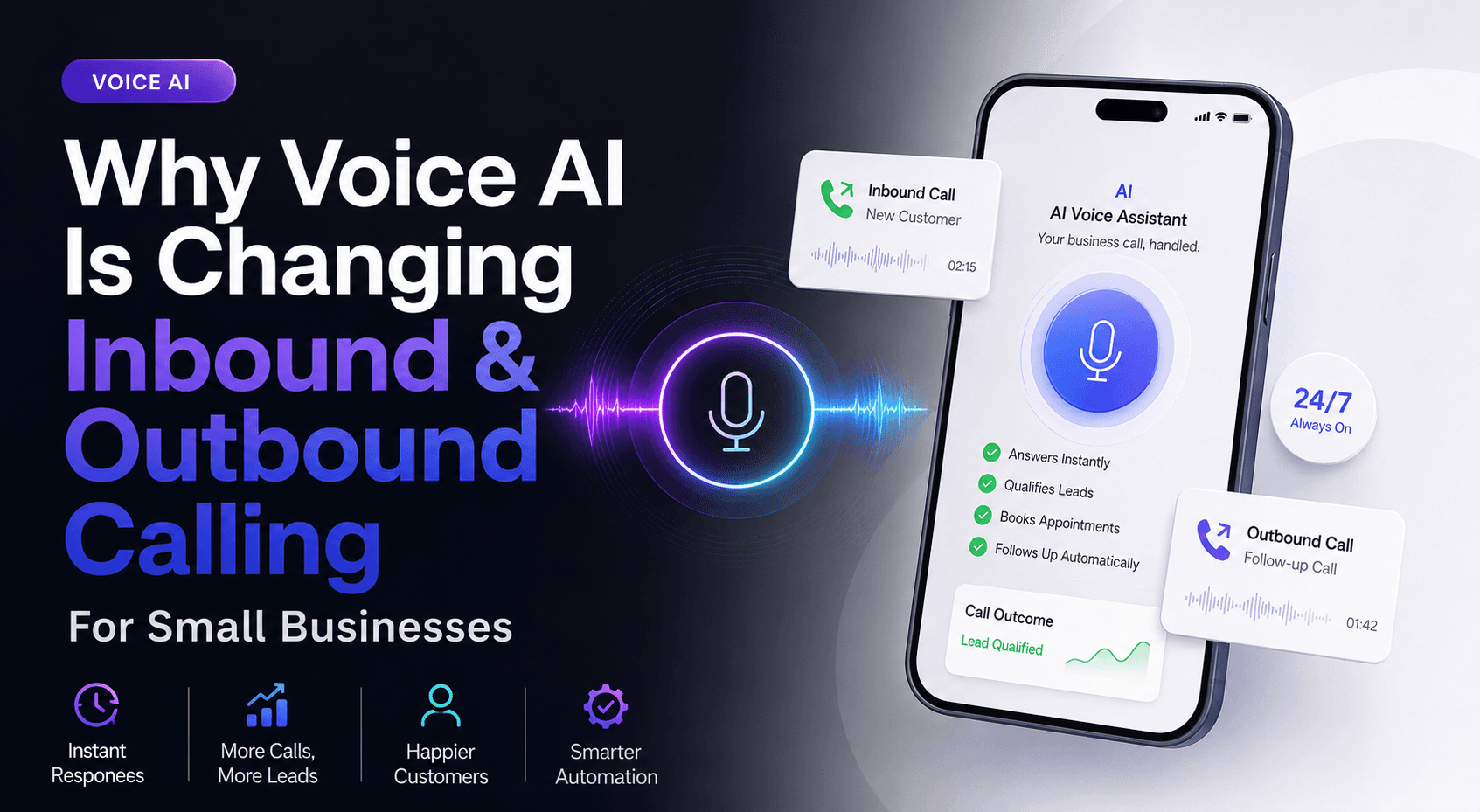
This is where Voice AI starts to matter. Not as a novelty, and not as a generic chatbot, but as practical phone coverage that answers, qualifies, books, routes, and follows up when your team cannot. Here are eight ways to use it to cut missed calls without making the experience feel cold or scripted.
1. Let Voice AI cover the hours your front desk cannot
The simplest win is after-hours coverage.
A caller who reaches voicemail at 6:12 p.m. is not thinking, I’ll patiently wait until tomorrow. Usually they are calling the next business on the list. A Voice AI receptionist keeps that conversation alive by answering naturally, asking what the caller needs, and capturing enough detail to move the request forward.
We have found this works especially well for businesses with uneven phone coverage: med spas, home services, law offices, clinics, brokerages, and field-service teams. The goal is not to solve every problem after hours. The goal is to avoid dead air and keep intent from leaking out of the funnel.
This is also where Voice AI feels very different from a static menu tree. Zendesk’s 2026 CX Trends reporting says 83% of CX leaders believe Voice AI can significantly evolve customer experience, and 76% of consumers would choose companies that support seamless conversations across channels. That matters because after-hours callers often need a smooth handoff into text, email, or a next-day callback.
Practical takeaway: start by covering nights, weekends, and lunch rushes first. Those are usually the cheapest missed-call leaks to fix.
2. Replace voicemail before it silently kills urgency
Traditional voicemail is passive. It asks the caller to do extra work, then hopes someone follows up fast enough.
That is a bad bet.
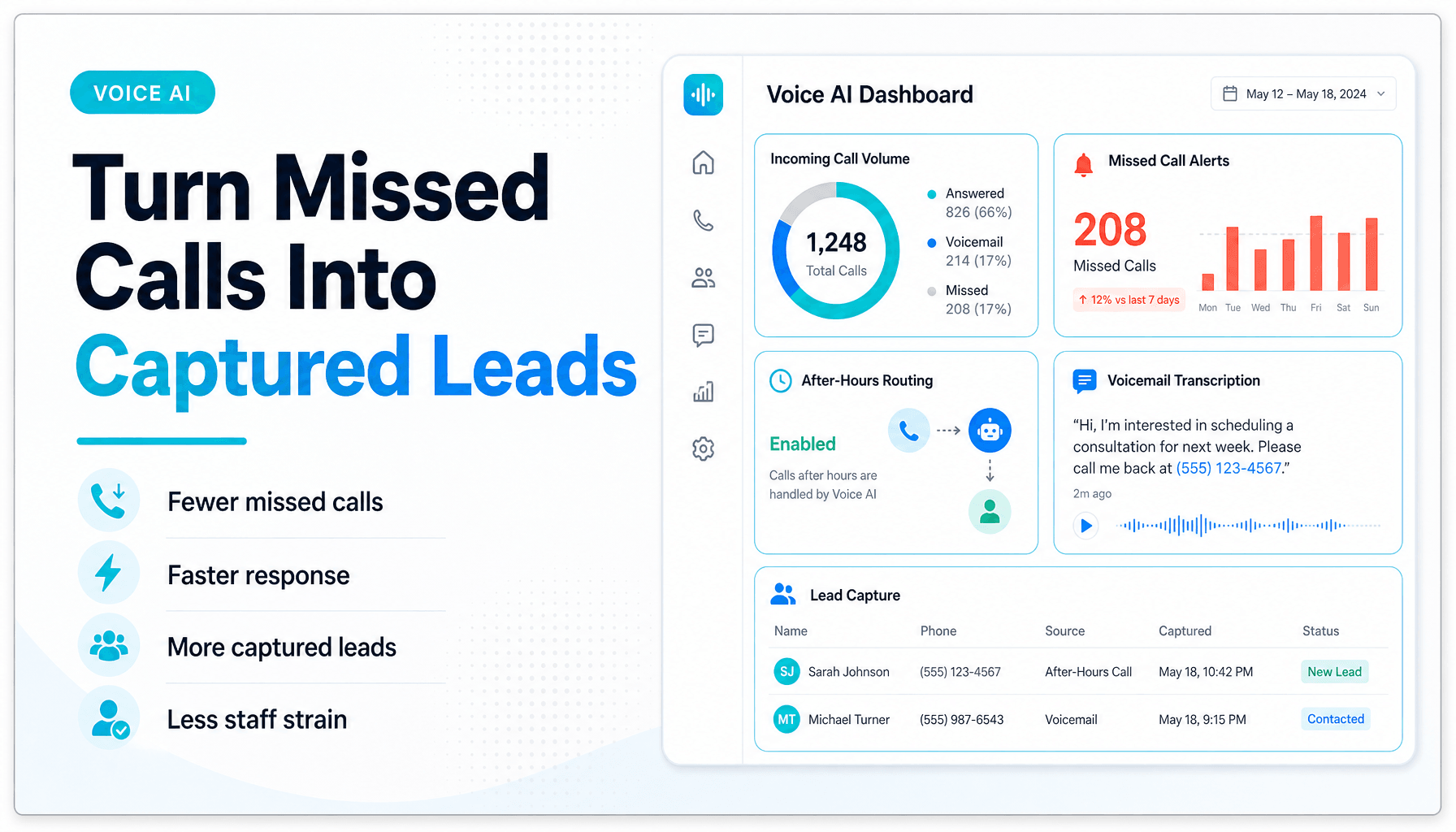
A better pattern is to let Voice AI answer in real time, gather context, and respond like a live assistant: Can I get your name, the reason for your call, and how urgent this is? That tiny shift changes the whole interaction. Instead of leaving a message into a void, the caller feels heard.
The surprising part is not that this improves service. It is that it often improves internal response quality too. Staff are no longer listening to rambling voicemails and trying to decode names, numbers, and urgency from bad audio. They get structured information instead.
What information to collect every time
At minimum, your Voice AI should capture:
- full name
- best callback number
- reason for calling
- whether the caller is a new lead, current customer, or other
- urgency level
- preferred response window
- any booking or service details needed for the next step
If the business depends on inbound leads, this pairs naturally with a structured intake flow like the one in this guide to building an AI lead intake system, but the phone experience should stay shorter and more conversational.
Practical takeaway: if your current voicemail inbox produces unclear callbacks, Voice AI should first fix data quality, not just answer rate.
3. Do not send every caller to a human first
A lot of owners assume the safest move is to get every caller to a person as fast as possible. In practice, that creates bottlenecks, interrupts staff, and leaves high-intent callers waiting behind low-value interruptions.
Voice AI works better when it qualifies first.
A short set of questions can separate urgent prospects from existing customers, vendor calls, spam, and routine informational requests. That means humans spend their time where it counts. It also shortens the path for callers who need action now.
The key is to keep it tight. Three useful questions usually beat ten “smart” ones.
Use simple branching questions
Think in branching logic, not giant scripts:
If caller says "new customer" -> ask service needed -> ask timeline -> ask location
If caller says "existing customer" -> ask account or job detail -> route to support
If caller says "vendor" -> capture company and reason -> send to admin queue
If caller sounds urgent -> mark priority and escalate
This is the same operating principle behind our guide to 9 tools to automate lead qualification without adding SDR headcount, just adapted for voice. The best qualification flows feel like a helpful receptionist, not a compliance form.
Practical takeaway: write branching questions around business decisions, not curiosity. If the answer will not change routing or priority, do not ask it.
4. Routing should follow business value, not org charts
Most phone systems route based on department names. Callers do not think that way.
They think: I need a quote, I need to reschedule, I have a problem, I need someone now. Voice AI should route around those intents, then layer in priority rules underneath.
That matters because misrouted calls create the exact kind of friction customers remember. Zendesk’s 2026 voice AI coverage notes that effective Voice AI can save at least 20% of agents’ time, partly by reducing repetitive handling and better directing conversations from the start.
Set routing rules by intent and priority
A practical routing model looks like this:
Caller typeTriggerDestinationPriorityHigh-value new leadNew project, urgent need, qualified location/budgetSales owner or fastest-response repHighExisting customer issueActive account, support requestSupport queue or account managerHighAppointment requestWants available slotBooking workflowMediumFAQ callHours, service area, pricing basicsAI answer first, then fallbackLowVendor or non-customerPartnership, sales pitch, misc.Admin inboxLow
If your business already struggles with handoffs, how to automate lead follow-up is a useful companion read because routing only works if the next step happens fast.
Practical takeaway: define “high priority” in business terms like revenue, urgency, and customer status, not just “who called first.”
5. Book the appointment while intent is still hot
One of the most expensive phone mistakes is making interested callers wait for a callback just to schedule.
That delay is where deals die.
If someone calls ready to book, Voice AI should be able to check availability, offer time slots, confirm the choice, and trigger the confirmation workflow immediately. This matters more now because customers increasingly expect self-serve or instant scheduling. SimplyBook.me’s 2025 Global State of Bookings report analyzed 25.4 million bookings processed in 2024 and found continued booking growth into 2025, with digital self-scheduling becoming standard behavior.
Reduce drop-off during scheduling
What actually goes wrong in small businesses is not calendar software. It is the gap between interest and confirmation.
A caller asks for Thursday afternoon. The receptionist is busy. Someone promises to call back. The prospect keeps shopping.
That is why live scheduling matters. If the phone interaction can move directly into booking, you remove an entire failure point. For service businesses, this pairs well with appointment booking automation for service businesses, especially when reminders and confirmations are part of the same flow.
Practical takeaway: if your staff currently “takes a message for scheduling,” that is your best first booking automation target.
6. Send follow-up before the caller has time to wonder what happens next
A strong call should end with immediate confirmation.
Voice AI can trigger an SMS or email the second the conversation ends: Thanks for calling. Here is your appointment request, callback window, or next step. That one message reduces uncertainty and cuts repeat calls from people checking whether their message went through.
For teams, the bigger operational benefit is the internal summary. A rep returning the call should not have to start blind.
Include call summaries for internal teams
A good summary includes:
- who called
- what they wanted
- how urgent it sounded
- whether they were qualified
- any promised next step
- transcript link if needed
This is where CRM Automation starts paying off. If the call summary lands in your CRM, help desk, or shared inbox automatically, the handoff is faster and cleaner. It also complements workflows like automatically researching leads with AI agents, because your team gets both the call context and the account context in one place.
Practical takeaway: never make staff listen back to full recordings for routine callbacks unless there is a dispute or edge case.
7. Let Voice AI absorb the calls humans should not be answering live
Not every inbound call deserves real-time staff attention.
Hours, service areas, payment methods, basic pricing ranges, office directions, reschedule policies, required documents, and availability checks are all common examples. When humans keep answering these same questions all day, the real cost is not just labor. It is opportunity cost. Staff get pulled away from sales conversations, problem-solving, and in-person service.
Voice AI is a strong fit here because phone callers often want quick clarity, not a full support experience. Salesforce’s 2026 service agent research found that adoption of AI agents in customer service organizations rose from 39% in 2025 to 66% in 2026, which reflects how quickly teams are moving routine interactions into automated channels.
Use Voice AI to deflect low-value calls
This is where a mild warning matters: do not over-automate. If your Voice AI tries to improvise policies, quote custom work, or handle emotional complaints without guardrails, it will create more cleanup than it saves. Salesforce’s analysis of why AI voice agents are harder than they seem makes this point well: voice systems fail when latency, turn-taking, and ambiguity are handled poorly.
Practical takeaway: automate repeatable questions with clear answers. Escalate anything custom, sensitive, or high-stakes.
8. Missed-call reporting tells you where your process is actually broken
Most owners look at missed calls as isolated events. The better view is operational.
When you track missed-call patterns, you start seeing where workflow is failing: lunch coverage, callback lag, poor routing, overflow during promotions, or one location consistently dropping calls on Saturdays.
In practice, this is often the most valuable long-term use of Voice AI because it turns phone traffic into management data.
Track the right metrics
Focus on metrics that help you act:
- missed-call rate
- after-hours call volume
- peak call windows by day
- AI resolution rate
- appointment conversion rate
- callback speed
- qualified lead rate
- transfer rate by intent
- repeat-call rate within 24 hours
The Maple dataset is a good example of why this matters. In its 1.2 million-call analysis, 68% of calls clustered during peak rush windows and AI handled 92% of calls without human intervention. Even if your numbers differ, the lesson is the same: once you know when and why calls are being missed, staffing and workflow decisions get much easier.
Practical takeaway: if you cannot say when missed calls happen most often, you are guessing about the fix.
The Bottom Line
The best Voice AI rollouts do not begin with a massive phone-system overhaul. They begin with one specific missed-call problem: after-hours coverage, voicemail replacement, live qualification, or appointment booking. Fix that first, measure the result, then expand into routing, follow-up, and reporting.
That is usually how durable AI Automation gets built. One operational leak at a time.
If you want a Voice AI system that actually answers calls, captures intent, qualifies leads, and connects to the rest of your workflow, AI-Automated builds practical systems for exactly that. We help small businesses turn missed calls into booked conversations, cleaner handoffs, and faster response times without adding more front-desk headcount.