AI Lead Intake System: Route, Score, Respond
What if your leads are not slipping because you need more traffic, but because your first 10 minutes are broken?
That is the real problem for a lot of teams. In the Artemis 2026 Speed to Lead Benchmark, companies responding in under 5 minutes were the baseline for maximum revenue capture, while waiting 5 to 30 minutes correlated with a 58% conversion loss and waiting 1 to 4 hours correlated with a 90% conversion loss. If your intake process still depends on someone noticing a form fill, checking the CRM, researching the account, and deciding who owns it, your funnel is leaking before sales even starts.
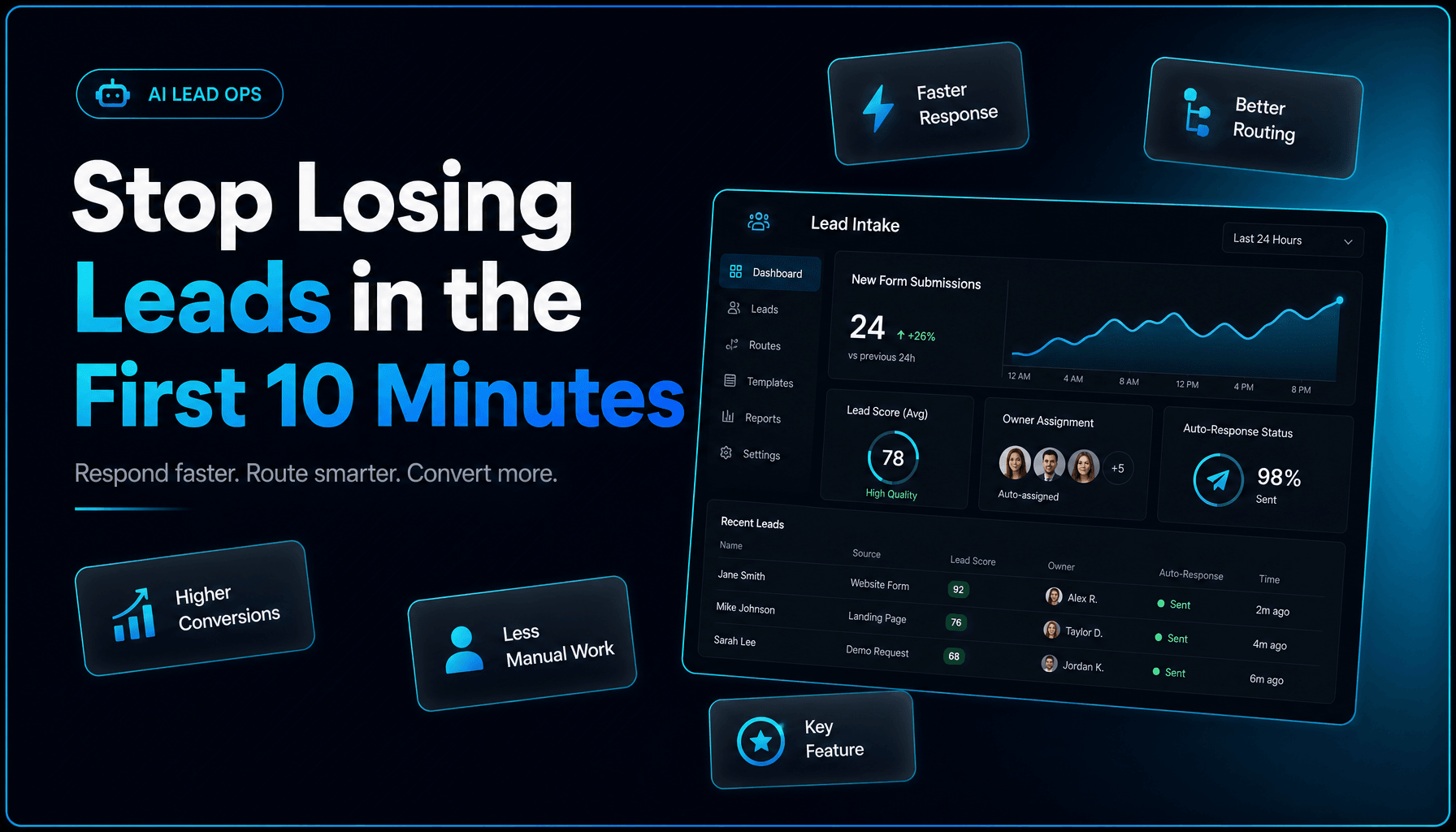
A strong AI lead intake system fixes that. It does three jobs at once: it responds fast, it scores fit using real business rules, and it routes the lead to the right person or workflow without manual triage. Done well, this is not just Workflow Automation. It is a cleaner revenue system.
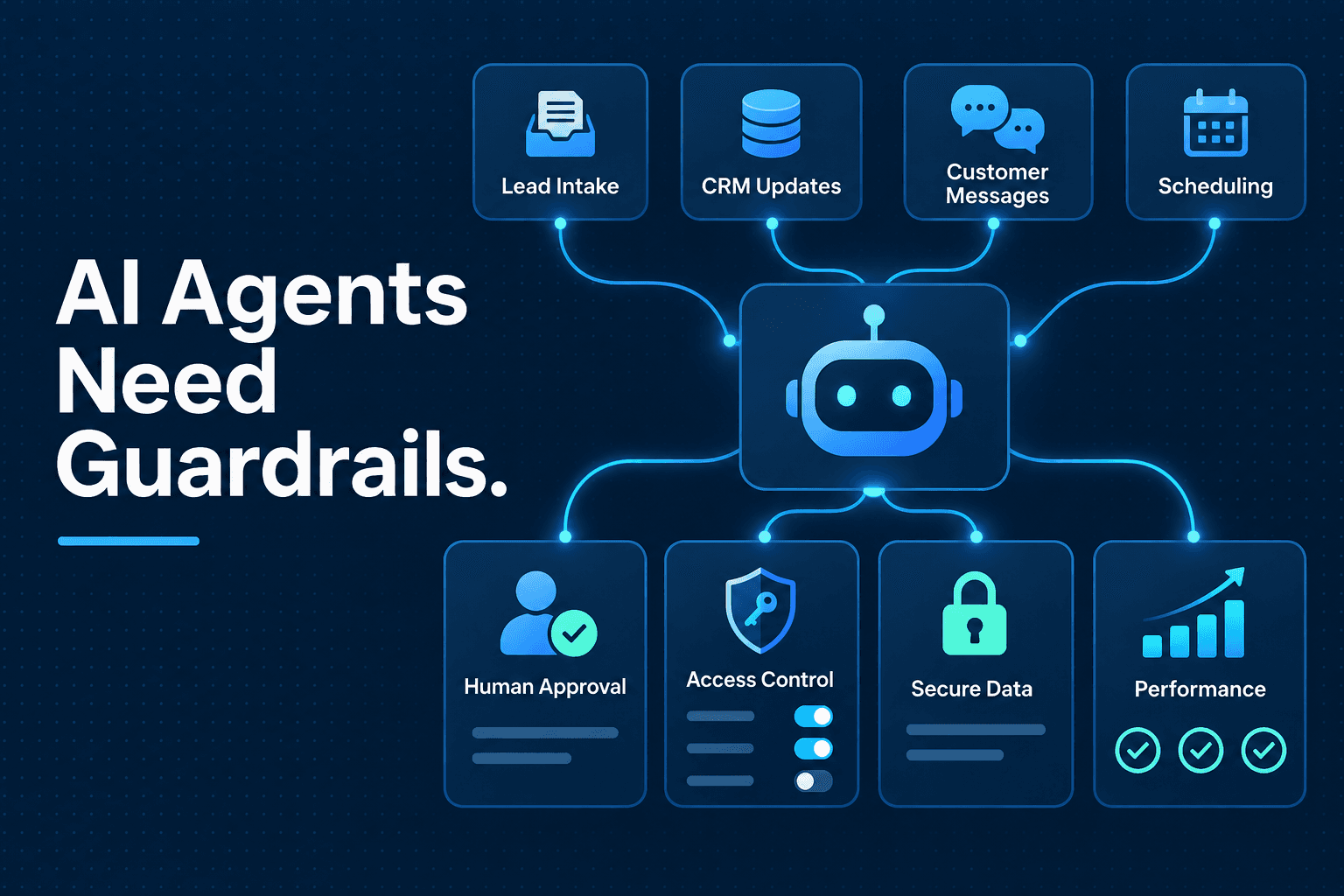
We’ve found the best setups are boring in the right places. They do not try to “fully automate sales.” They capture intent, enrich context, write structured data into the CRM, and trigger the next step immediately. That is where AI Agents, CRM Automation, and practical Lead qualification start to pay off.
The first failure is not scoring, it is silence
Most teams start by asking how to build a better score. In practice, the first problem is usually that nobody replies fast enough.
A lead submits a demo form at 4:42 PM. The sales rep sees it the next morning. Marketing assumes sales followed up. Sales assumes the lead was low intent. The lead has already booked a competitor.
That is why the first layer of your system should be an automatic response, not a complex model.
Your intake flow should immediately:
- acknowledge the inquiry
- capture a few routing fields
- create or update the CRM record
- assign ownership
- trigger the next touch
This is where a lot of small businesses get stuck. They add forms, chat, email, maybe even Voice AI, but the systems are not connected. If you need a broader view of how these automations fit together, our guide to AI Automation ideas for small business is a useful starting point.
The business case is simple. In Salesforce’s State of Sales, 7th Edition, high-performing teams were 1.7 times more likely than underperformers to use AI prospecting agents. That does not mean agents close deals by themselves. It means the best teams are using AI upstream, where speed and consistency matter most.
If your current process relies on humans to do first-pass triage, the fix is not “train reps to be faster.” The fix is to remove the waiting.
Do not score everything, score for one decision
The fastest way to build a bad lead scoring system is to make it too smart.
We’ve seen teams create 30-point scoring matrices that combine industry, headcount, job title, page views, email opens, ad source, and random enrichment fields. Then nobody trusts the output because the score is hard to explain.
A better approach is to score for one operational decision: what should happen next?
For most businesses, your score only needs to answer one of these:
- send to sales now
- put into nurture
- ask one more qualifying question
- flag for human review
That is a much more useful design target than chasing a perfect number.
A practical scoring schema often includes:
- Fit score: how closely the account matches your ICP
- Intent score: what the lead has done right now
- Confidence score: how trustworthy the data is
That third field matters more than people think. The contrarian truth is that weak lead intake systems usually fail because they hide uncertainty. The agent finds a vague company website, guesses an industry, writes a confident summary, and pushes the record to sales as if the data were solid. That is how bad routing becomes “automation.”
We’ve found structured outputs work better than freeform summaries. Instead of a paragraph, store fields like:
| Field | Purpose |
|---|---|
| industry | Match against target verticals |
| company_size_band | Screen for deal fit |
| use_case | Inform outreach angle |
| fit_score | Support routing |
| confidence_level | Decide whether a human should review |
| recommended_next_step | Trigger workflow |
If you want examples of tools that support this kind of process, see our breakdown of 9 tools for automating lead qualification without adding SDR headcount.
Your routing rules should look more like ops logic than AI magic
A good intake system is not just an agent with a prompt. It is a set of clear rules around ownership, escalation, and fallback paths.
What actually works is simple logic like this:
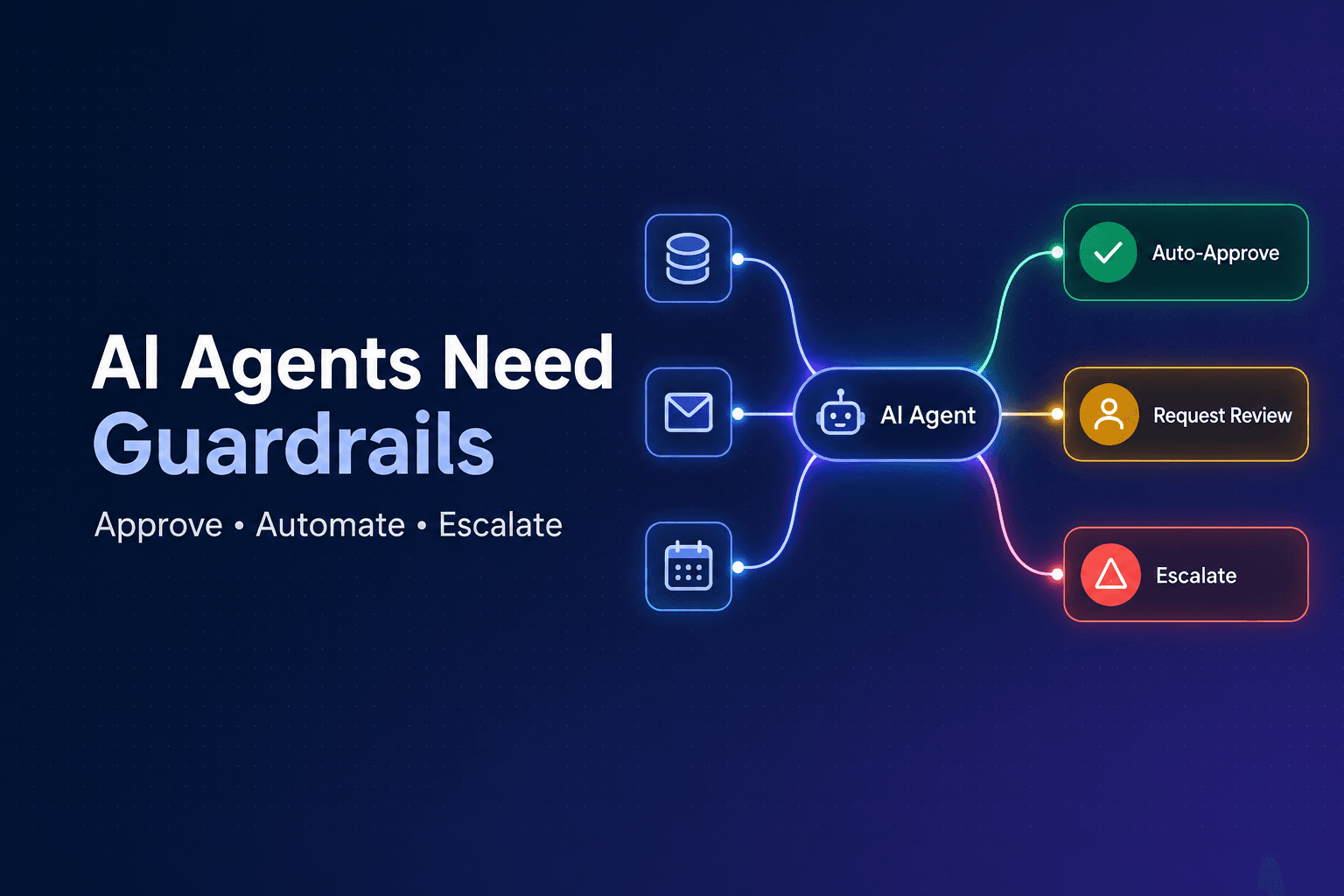
If fit_score >= 80 and intent_score >= 70:
  assign to account executive
  create task due in 10 minutes
  send personalized acknowledgment email

If fit_score between 50 and 79:
  assign to SDR queue
  trigger AI research brief
  enroll in short follow-up sequence

If confidence_level is low:
  route to manual review
  do not trigger personalized claims

If lead is outside geography or company-size threshold:
  send nurture response
  mark as disqualified with reason
That is not flashy, but it is dependable.
This is also where Multi-agent Systems can help. One agent can classify the lead, another can enrich company data, and a third can generate a short sales brief. But the handoffs need guardrails. If you are designing more complex agent workflows, our post on how to build a multi-agent AI workflow for your business goes deeper on roles, handoffs, and failure points.
The key lesson is that routing should be auditable. A sales manager should be able to look at any record and understand why it went where it went. If the answer is “the model decided,” trust will disappear fast.
The data problem is usually bigger than the model problem
Most broken intake systems do not fail because the prompt is weak. They fail because the CRM is messy.
Duplicate records, missing lead source, inconsistent lifecycle stages, half-filled company names, and unclear ownership rules will wreck automation long before model quality becomes the bottleneck. This is why CRM Automation has to include record hygiene, not just new workflows.
What we usually recommend first:
- standardize required intake fields
- set duplicate detection rules
- separate raw enrichment from verified fields
- log confidence and source for key values
- create a manual review queue for conflicts
This matters because AI can make dirty systems look productive for a short time. You will see more activity, more summaries, more updates. Then 30 days later, reps stop trusting the CRM because records disagree with each other.
A useful mental model is this: the intake system should create a shared lead picture for marketing, SDRs, account executives, and RevOps. If each team still has to re-check the account before acting, the automation did not really save time.
That is one reason we often pair intake automation with adjacent workflows like how to automatically research leads using AI agents. Intake is the trigger. Research, scoring, and follow-up are the layers that make the trigger useful.
The reply should feel fast, specific, and safe
A lot of automated lead responses are technically instant and commercially useless.
They say things like, “Thanks for reaching out. Someone will contact you soon.” That is not helpful. It does not move qualification forward, and it does not give the buyer confidence that you understood anything.
A better automatic response should do one of three things:
- confirm the exact request
- ask the next best qualifying question
- offer the next action, like booking or callback
For example, a real estate team might send:
- “Thanks for reaching out about homes in Scottsdale. Are you looking to buy in the next 30 days, 3 months, or later?”
A home services company might send:
- “Got it, you need HVAC service in Austin. Is this urgent, or are you comparing quotes for a planned job?”
A B2B agency might send:
- “Thanks for the request. To point you to the right specialist, are you looking for help with lead generation, CRM cleanup, or workflow automation?”
That is where AI Automation becomes practical. It uses what the lead already submitted, enriches context, and asks only the next useful question.
HubSpot’s 2025 State of Sales Report found that 74% of sales pros believe AI is making it easier for buyers to research products. That means your inbound lead often arrives more informed and less patient than before. Generic replies feel worse in that environment, not better.
If your business depends on fast inbound conversations, this is also why Voice AI is getting more attention. It can handle the same first-pass intake logic over phone channels where forms are not the starting point.
If you cannot measure these four numbers, the system is not finished
A working intake system is not “done” when the workflow runs. It is done when you can prove it improved pipeline behavior.
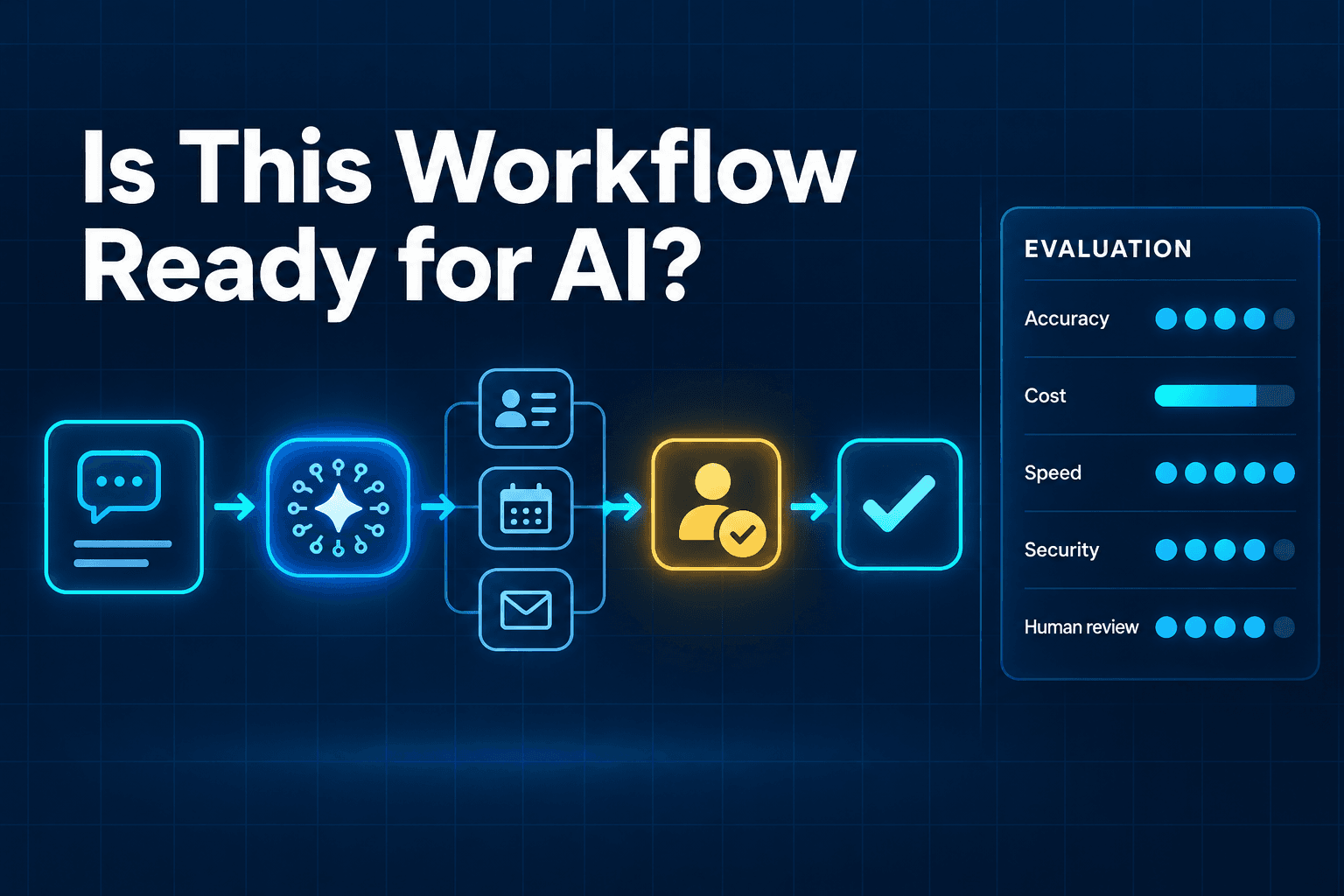
Track these four metrics first:
- time to first response
- lead-to-meeting rate
- qualified lead rate
- routing accuracy
Then add a second layer:
- manual review rate
- duplicate creation rate
- low-confidence record rate
- speed from inquiry to owner assignment
This is where teams often learn something uncomfortable. Faster response does not always mean better qualification. Sometimes a system increases meetings while sending too many weak-fit leads to sales. Sometimes a scoring model is conservative and protects rep time, but slows growth. You need both speed and quality.
In practice, the best intake systems improve conversion by removing dead time, not by pretending to be perfect judges of buyer intent. They make the first handoff cleaner, the first reply faster, and the next step obvious.
If you are still deciding what kind of setup fits your business, our guide on how to choose the right AI solution for your business in 2025 can help you avoid buying tools that look impressive but do not fit your workflow.
A good rule: if you cannot explain why a lead was scored, routed, and answered the way it was, the system is too complex.
Build the handoff first, then make it smarter
The best AI lead intake systems are not the ones with the most prompts, integrations, or dashboards. They are the ones that remove the messy handoff between interest and action.
Start with one pipeline. Define what a qualified lead actually looks like. Decide which fields are required, which signals matter, and what should happen at each score band. Then automate the first response, the routing logic, and the CRM update. After that, you can add better enrichment, more nuanced scoring, and more specialized AI Agents.
That order matters. If the handoff is broken, extra intelligence just makes the mess happen faster.
If you want help designing an intake system that routes leads faster, improves Lead qualification, and writes cleaner data back to your CRM, AI-Automated builds practical systems for exactly that. We help small businesses, agencies, and operations-heavy teams turn inbound chaos into a workflow your sales team can actually trust.