How to Build an AI Intake System for Service Businesses
What if your intake process is not slow because your team is lazy, but because your business still treats every new inquiry like a sticky note?
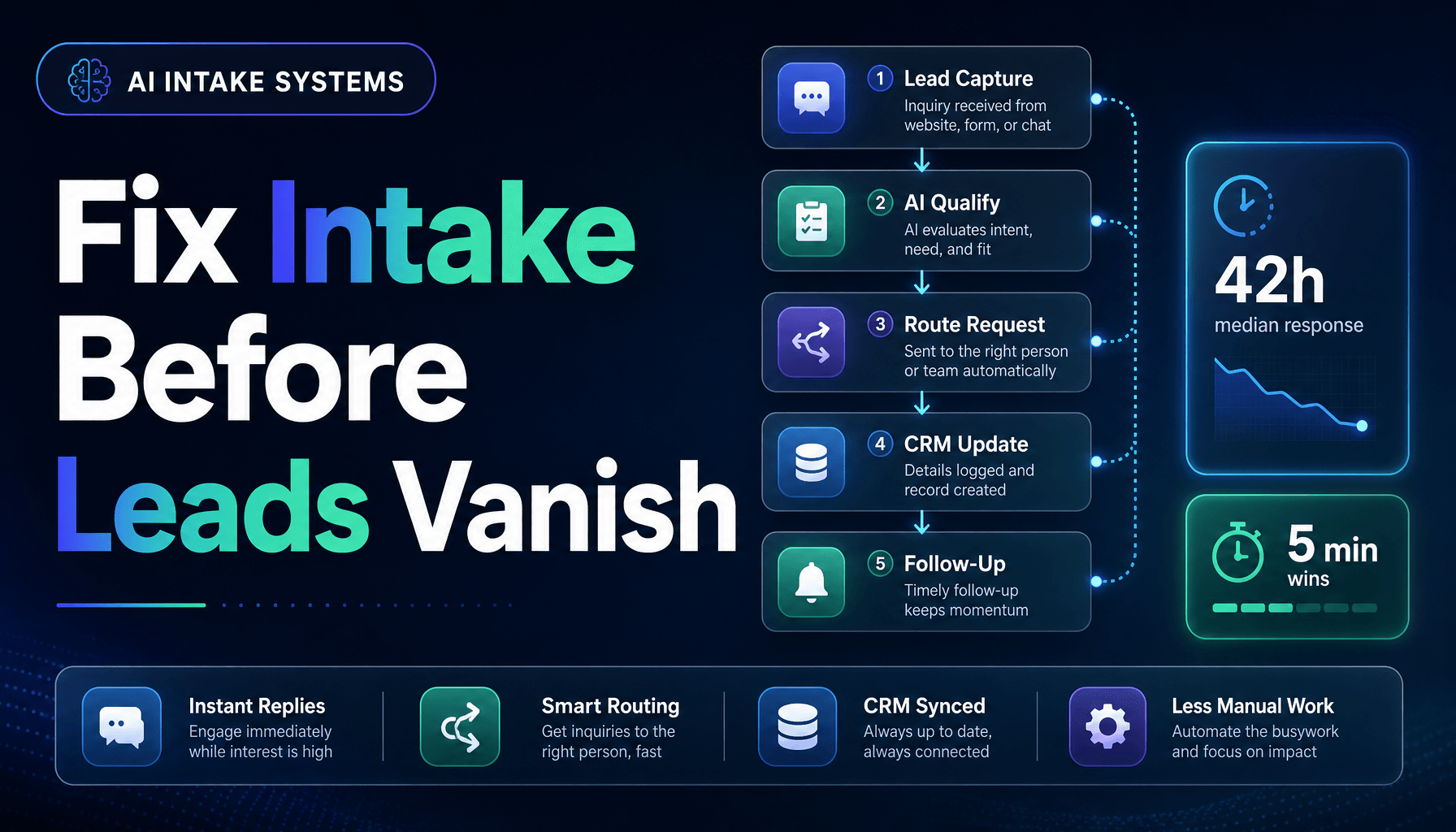
That sounds harsh, but the math is harsher. The Artemis 2026 Speed to Lead Benchmark found a 42-hour median lead response time, and only 7% of companies consistently reply within five minutes. For service businesses, that delay is brutal. A missed plumbing call, a late medspa form reply, or a buried legal inquiry rarely waits around to be loved better tomorrow.
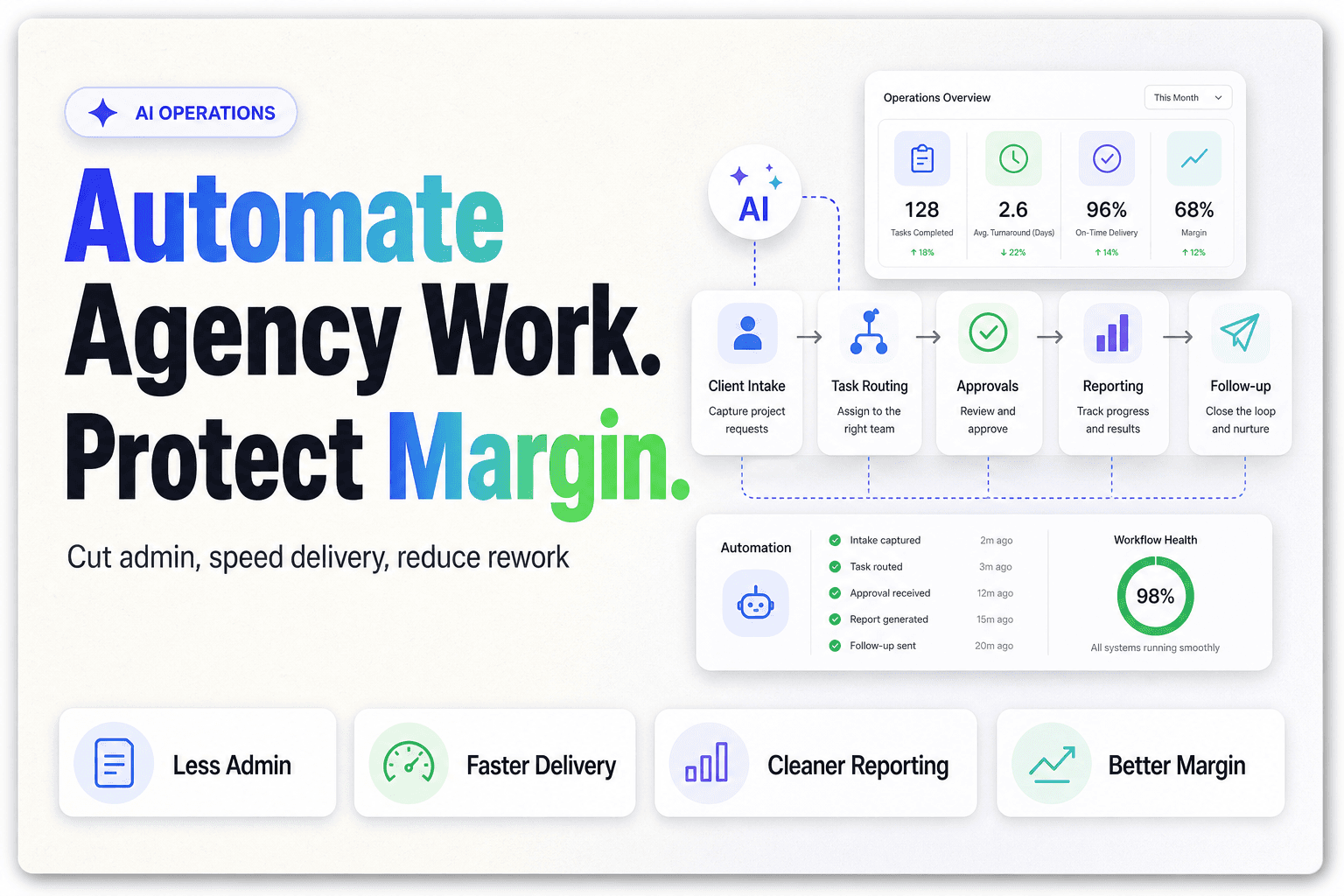
A solid AI intake system fixes that first moment. It captures the inquiry, qualifies it, routes it, updates the CRM, and starts the next action before your team has time to say, “Did someone get that?” In practice, this is where AI Automation, AI Agents, Workflow Automation, and CRM Automation stop being buzzwords and start acting like a front desk that actually shows up.
The biggest leak is not traffic, it is the first 10 minutes
Most service businesses think they have a lead generation problem. We’ve found they usually have an intake problem.
The ad works. The referral comes in. The caller is ready. Then the inquiry hits a contact form, voicemail box, shared inbox, or text thread and just sort of... ferments.
That first 10-minute window matters because intent is highest right after the prospect reaches out. A homeowner with a burst pipe, a parent booking urgent tutoring, or a patient looking for an appointment is not browsing casually. They want an answer, a next step, or at minimum proof that someone is alive on the other end.
A strong intake system should do five things immediately:
- acknowledge the inquiry
- capture structured details
- decide whether the lead fits
- route it to the right person or queue
- trigger the next action without manual triage
If your team is still piecing this together by hand, you are paying for delay in hidden ways:
- lower booking rates
- more no-shows from weak follow-up
- duplicate CRM records
- staff time wasted on sorting instead of serving
- hot leads cooling off while everyone “checks the calendar”
This is also why intake should not live in one channel. Forms, chat, SMS, web calls, and after-hours voice all need to feed the same logic. If your process still depends on separate inboxes and heroic memory, you do not have a system. You have a scavenger hunt.
For a broader look at how these handoffs connect to revenue, our guide on why speed to lead still wins in 2026 pairs well with this conversation.
Do not start with AI, start with your routing rules
This is where teams get a little too excited and a little too vague.
They say they want an AI intake system, but what they actually need is a clear decision tree. If a human receptionist cannot explain how inquiries should be categorized, the model will not magically invent operational clarity for you.
Before you build anything, define:
What counts as a qualified inquiry
Not every lead deserves the same path. A good service-business intake flow usually sorts by:
- service type
- location or service area
- urgency
- budget or insurance fit
- appointment intent
- existing customer vs new prospect
A cleaning company might route same-week move-out requests differently from recurring residential leads. A medspa may separate consultation requests from post-treatment support. A law firm may need different handling for practice area, jurisdiction, and case urgency.
What needs automation, and what needs a human
This part matters more than people think. The best intake systems are not “fully autonomous.” They are selective.
Use automation for:
- collecting standard details
- answering simple availability questions
- writing records into the CRM
- sending confirmations
- assigning ownership
- triggering reminders or follow-up tasks
Use humans for:
- unusual edge cases
- sensitive customer conversations
- high-value sales consults
- exceptions that require judgment
If you are building more complex routing across specialized roles, our complete guide to multi-agent AI systems for small business operations shows how separate agents can handle intake, qualification, CRM updates, and QA without turning one bot into an overworked intern.
Your intake system should collect less, then do more
A lot of broken intake flows have the same disease: they ask too many questions too early.
Long forms feel thorough to the business and annoying to the customer. In practice, the goal is not to collect every possible field upfront. It is to collect enough to take the right next step.
For most service businesses, that means the intake layer should capture:
FieldWhy it mattersName and contact infoSo you can respond immediatelyService neededSo the request is classified correctlyLocationSo you can check service area or assign territoryTiming or urgencySo urgent jobs do not sit in the wrong queuePreferred channelSo follow-up happens where the customer will actually replyShort context noteSo the team is not walking in blind
Then let the system do the enrichment behind the scenes.
This is where AI Agents earn their keep. Instead of forcing the lead to fill out eight extra fields, the system can:
- standardize messy entries
- infer service category from free text
- flag duplicates in the CRM
- pull past customer history
- score urgency
- suggest next-best action
That kind of back-end cleanup matters because bad data spreads fast. One messy lead record becomes three conflicting records, two missed follow-ups, and one confused account owner. If CRM hygiene is already hurting response time, 7 ways to use AI agents to clean up CRM data automatically is a useful next read.
The customer sees a simple intake experience. Your team gets structure, context, and cleaner records. That is the trade worth making.
If every inquiry goes to the same queue, your system is still manual
Here is the mildly contrarian part: many “AI intake” projects are just prettier forms bolted onto the same old bottleneck.
They look modern. They still route everything to one shared inbox, one front-desk person, or one overbooked coordinator. That is not automation. That is decorative plumbing.
Routing should reflect how the business actually works. A strong system sends different inquiries down different paths based on intent and value.
For example:
New inquiry received
→ Is this an existing customer?
  → Yes: pull account history and route to support or account owner
  → No: continue qualification
→ Is the request in service area?
  → No: send polite decline or partner referral
  → Yes: continue
→ Is urgency high?
  → Yes: alert live team or urgent call queue
  → No: standard booking flow
→ Is booking possible immediately?
  → Yes: send booking options and confirm
  → No: assign follow-up task with SLA
This matters even more as call behavior shifts. An Invoca 2025 study on Google AI-generated calls found pricing-request calls from Google’s AI surged more than 300% in November, especially in home services. That means service teams increasingly need intake logic that can handle not just human callers, but automated caller behavior too.
And if your business depends on inbound calls, you also need to plan for volume gaps. Maple’s analysis of 1.2 million calls across 1,000+ locations found businesses reported missing 33% of incoming calls during peak hours. Different vertical, same operational headache: demand tends to arrive when your staff is busiest.
That is why Voice AI is becoming part of the intake layer, not a separate experiment. If calls are a major intake channel for your business, 8 ways to use Voice AI to cut missed calls in a small business shows where it fits without making the experience robotic.
The failure is usually not the bot, it is the handoff
When owners say “AI did not work for us,” what actually happened is often much less dramatic.
The assistant captured the lead. The form worked. The reply sent. Then the handoff broke.
Maybe the CRM record was created without an owner. Maybe the calendar did not sync. Maybe the rep got notified but not the customer. Maybe the system classified a repair request as a new quote and sent the wrong follow-up. None of that feels like “AI failure” to the customer. It just feels like your business is disorganized.
This trust gap is real. A Gartner June 2025 survey found only 35% of customers who last interacted by phone were willing to adopt a generative AI digital assistant. In other words, customers are not grading your architecture. They are grading whether the experience worked.
So build handoff checks into the system:
- confirm every record gets an owner
- log every action back into the CRM
- trigger fallback alerts if no one responds within SLA
- review low-confidence classifications
- keep a human override path for sensitive cases
If you want the practical version of this warning label, our article on 10 common mistakes small businesses make when integrating AI covers the traps that show up after the demo and before the ROI.
Measure four numbers first, or you will not know if it works
The temptation is to measure vanity metrics like chatbot sessions or form completions. Resist it.
A service-business intake system should be judged by operational outcomes, not how busy the automation looks. We’ve found four metrics tell the truth fastest:
1. Time to first response
This is the headline metric. If the system is not shrinking response time, it is not fixing intake.
2. Qualified booking rate
How many inquiries become real appointments, consults, or sales conversations? Faster routing and better Lead qualification should lift this number.
3. Manual touches per inquiry
Count how many humans have to intervene before the lead is booked, routed, or closed out. Fewer unnecessary touches means the workflow is doing actual work.
4. CRM completeness at creation
A lead record missing service type, owner, source, or next step is not a lead record. It is future cleanup.
This is where market momentum helps make the case internally. In the McKinsey State of AI 2025 survey, 23% of respondents said their organizations were already scaling agentic AI in at least one function, while 39% said they had begun experimenting. Meanwhile, the Zendesk 2026 CX Trends report found 85% of CX leaders said one unresolved issue is enough to lose a customer.
That is the real business case. Better intake is not about looking innovative. It is about reducing the odds that a ready-to-buy customer disappears because your ops stack was asleep.
A good first 30-day scorecard looks like this:
- average first-response time
- percent of inquiries auto-routed successfully
- percent of inquiries booked without staff intervention
- duplicate lead rate
- no-owner CRM record rate
If those numbers improve, the system is working.
A good AI intake system is not a fancy chatbot with a nice greeting. It is a practical workflow that captures demand, qualifies it, routes it, and keeps your team from playing inbox detective all day.
For service businesses, that often means combining chat, forms, Voice AI, calendar logic, and CRM Automation into one intake layer that actually reflects how the business runs. It should feel simple to the customer and boringly reliable to your ops team. That is the sweet spot.
Free playbook
The Speed-to-Lead Playbook
Response benchmarks, a 5–8 touch cadence, qualification rules, and a 4-stage intake workflow — the system that stops inbound revenue from leaking between the form and the first real conversation.
Get the free playbookAt AI-Automated, we build custom intake systems that do exactly that: qualify leads, route requests, connect your tools, and help lean teams respond faster without adding headcount. If you want an intake process that stops leaking booked revenue, schedule a consultation and we’ll map the workflow with you.