How to Design an AI Lead Qualification Score That Your Sales Team Will Actually Trust
Most lead scoring models do not fail because the math is bad. They fail because sales looks at the score, laughs a little, and works the lead they were going to call anyway.
That trust problem gets expensive fast. In the Salesforce State of Sales, 7th Edition, 46% of sales pros with agents say data quality issues hurt their sales, which is a polite way of saying your shiny score is only as useful as the data feeding it. At the same time, Salesforce’s 2026 sales survey found that 87% of sales organizations already use AI for work like prospecting, lead scoring, and email drafting. So the question is no longer whether teams will use AI for qualification. The real question is whether your reps will believe what it tells them.
A good AI lead qualification score should do one job well: help your team decide who deserves attention right now, with enough clarity that nobody has to guess why a lead was prioritized.
If your score feels mysterious, reps will route around it
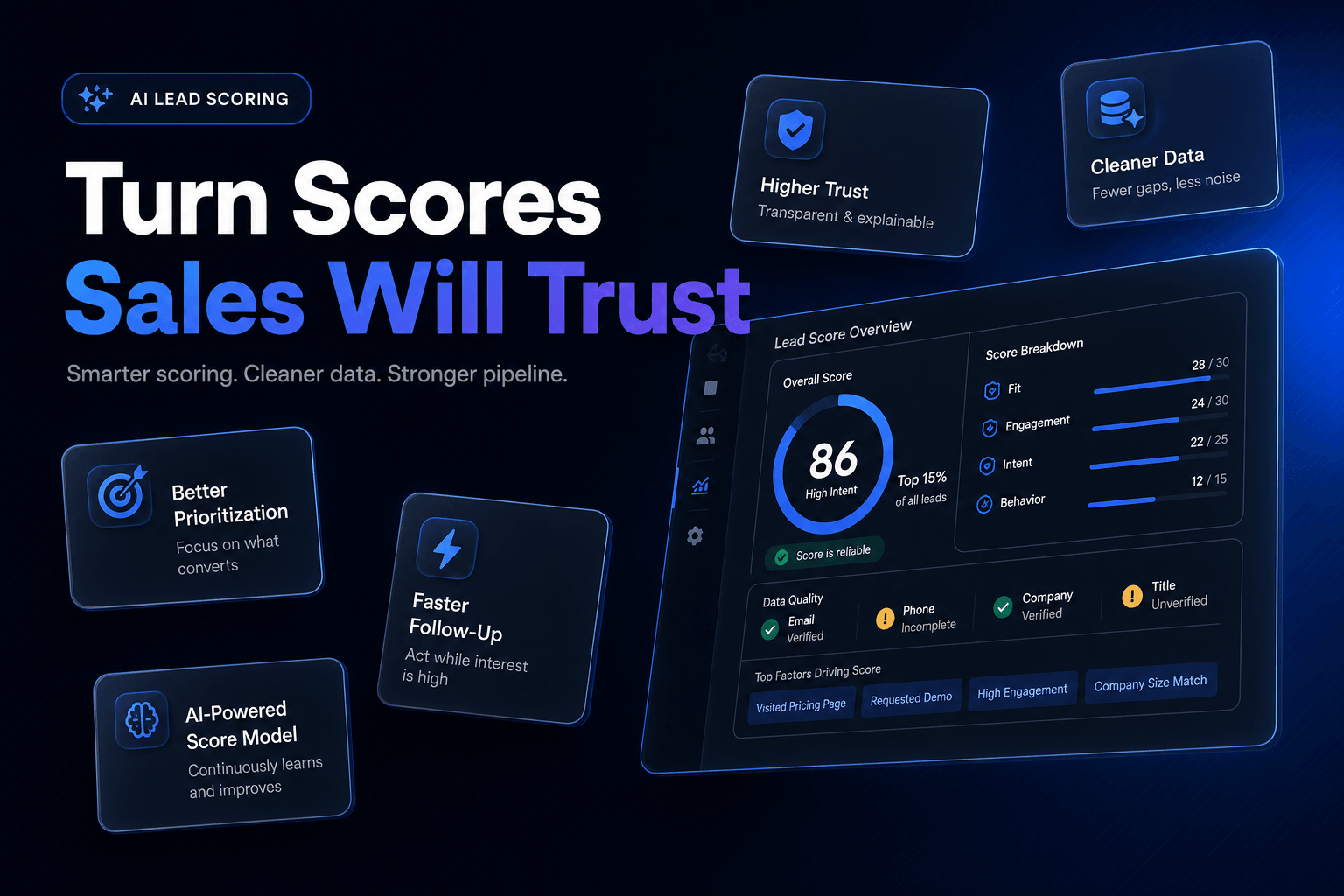
We’ve found the fastest way to kill adoption is to make the scoring model feel like a black box. If a rep cannot answer “why did this lead get an 84?” in plain English, the score becomes decorative.
That matters because AI already creates more capacity in sales. According to a May 2026 Gartner survey of 210 sales leaders, sellers save an average of 4.8 hours per week with AI. But more time does not automatically create better prioritization. If the queue is still confusing, reps just spend those hours chasing whichever lead “looks promising.”
That is why trusted scoring models need visible logic, not hidden magic.
A rep should be able to open a record and see something like:
- Fit score: industry, company size, geography
- Intent score: demo request, pricing visit, repeat high-value page views
- Urgency score: recent activity, call request, short decision window
- Confidence score: how complete and reliable the source data is
This is also why structured outputs matter. If your model dumps one long AI summary into the CRM, the rep still has to interpret it manually. We covered that issue in more detail in Why Structured Data Is the Secret Ingredient in Better AI Automations.
Trust starts when the score stops acting like a magician and starts acting like a decent analyst.
Don’t score “interest” by itself, score fit, timing, and evidence separately
A lot of teams still overweight soft engagement signals. One ebook download, two email opens, and suddenly a lead is labeled “hot.” That is how you create false positives and cynical reps.
In practice, the most trusted models separate three things that often get blended together:
- Company fit: Is this the type of account you actually sell to?
- Buyer timing: Is there a reason to believe the need is current?
- Evidence quality: Are these real signals or just noisy activity?
That split matters more now because B2B buying is messier than the old MQL playbook assumed. In the McKinsey 2026 Global B2B Pulse Survey, buyers use an average of 10 channels during the purchasing journey. If your score treats every action as equal, you end up rewarding volume of activity instead of buying readiness.
A cleaner model often looks like this:
| Component | What it measures | Example |
|---|---|---|
| Fit | ICP alignment | 150-person home services company in your service area |
| Intent | Buying behavior | Requested pricing twice in 48 hours |
| Urgency | Time sensitivity | Asked for a callback today |
| Confidence | Data reliability | Website, CRM, and enrichment data all match |
This is where AI Agents can help more than rigid rules. They can summarize context across form fills, email replies, call notes, and CRM history, then return a structured score with reasons attached.
If you want the surrounding system to act on that score automatically, pair it with a routing workflow like the one in How to Design a Lead Routing System That Sends Every Prospect to the Right Person.
The score should explain the next action, not just rank the lead
A lot of scoring models stop one step too early. They assign a number, then leave the rep to figure out what that number actually means.
That is a design mistake.
The best Workflow Automation setups tie scoring to action thresholds. A score should not just say “this lead is 78.” It should say what happens because it is 78.
For example:
- 80 to 100: route to sales now, create task, alert in Slack
- 60 to 79: send to SDR review queue with AI summary
- 40 to 59: enroll in nurture, revisit if new intent appears
- Below 40: store, monitor, no immediate rep action
This sounds simple, but simplicity is the point. According to Gartner’s May 2026 research, organizations that reinvest AI-driven time savings into high-impact activities are 3.1x more likely to exceed lead-to-opportunity conversion goals. A trusted score helps create that reinvestment because it reduces debate, hesitation, and random lead-picking.
What actually works is connecting the score to concrete operational moves:
Use the score to trigger systems, not meetings
Good scoring should trigger:
- CRM stage updates
- rep assignment
- follow-up sequences
- exception flags for low-confidence records
- manager review for strategic accounts
Bad scoring triggers a weekly argument about whether marketing sent “good leads.”
For follow-up timing, this is where How to Automate Lead Follow-Up and Why Speed to Lead Still Wins in 2026 and How AI Helps You Get There fit naturally into the same system.
The mildly annoying truth: more scoring factors usually make trust worse
This is the contrarian part. Teams love complexity because it feels smarter. In reality, overly detailed scoring models often become less believable, not more accurate.
We’ve seen teams build 20-factor models with behavioral signals, technographics, engagement weights, keyword sentiment, title mapping, territory adjustments, and manual override logic stacked on top. Nobody trusts those models because nobody can audit them quickly.
That skepticism is not irrational. In McKinsey’s July 2026 report on agentic AI in B2B sales, the firm points to familiar blockers: fragmented data, weak insights, manual processes, disconnected teams, and limited change management. In other words, teams rarely fail because the model was too simple. They fail because the operating environment was a mess.
A more trustworthy launch model usually has:
- 5 to 7 scoring inputs, not 25
- one clear owner in RevOps or sales ops
- visible reasons on every high-priority score
- a confidence flag when source data is thin
- a monthly review against real conversion outcomes
If your team wants a more complex setup later, fine. Earn that complexity. Start with a model that a sales manager can explain in under two minutes without opening a diagram the size of a parking lot.
Your reps do not need a perfect score, they need a score that loses gracefully
A trusted model does not pretend to be right 100% of the time. It shows when the system is uncertain.
This is where many AI Automation projects quietly go sideways. The model assigns precise-looking numbers to messy real-world data, and people mistake precision for confidence. A lead with a vague Gmail address, missing company size, and a half-finished form should not receive a confident score just because the system can generate one.
Instead, build in graceful failure:
Add a confidence layer
Use a separate field such as:
- High confidence: complete CRM and firmographic match
- Medium confidence: partial data, some inferred fields
- Low confidence: missing or conflicting inputs, human review needed
That one layer does two useful things. First, it protects reps from bad automation. Second, it protects the model’s reputation. Sales will forgive an uncertain score faster than a confidently wrong one.
This is especially important if your workflow also updates records automatically. If the data foundation is shaky, start by cleaning the system of record first. That is exactly why The Complete Guide to CRM Automation for Teams That Hate Manual Data Entry and 7 Ways to Use AI Agents to Clean Up CRM Data Automatically matter before you pile more intelligence on top.
Measure whether the team trusts it, not just whether the model predicts well
Here is the part many teams skip: technical accuracy is not the same thing as operational trust.
You can have a model that looks great in a dashboard and still gets ignored by the floor. So your measurement framework needs both outcome metrics and usage metrics.
Track the obvious performance numbers:
- lead-to-meeting rate by score band
- lead-to-opportunity rate by score band
- average response time for high-score leads
- pipeline created from high-confidence leads
Then track the trust signals:
- percentage of high-score leads actually contacted
- manual overrides by reps or managers
- rep agreement rate on “sales-ready” status
- low-confidence records escalated for review
- score drift over time by source or channel
According to the Salesforce State of Sales, 7th Edition, 51% of sales pros say security concerns delayed AI initiatives. That is a useful reminder that trust is not just about model logic. It is also about governance, data handling, and whether teams believe the system is safe enough to rely on.
If reps keep overriding your score, do not blame the reps first. Usually they are surfacing a flaw in the model, the data, or the handoff logic.
A trusted lead qualification score is less like a final verdict and more like a disciplined first pass. It helps your team move faster, but it also shows its work.
If you want to build that kind of system, start with a narrow workflow: define your ideal customer profile, separate fit from intent, attach reasons to every score, and connect the result directly to routing and follow-up. Then refine it on real outcomes, not committee opinions.
That is the kind of CRM Automation and AI lead qualification setup we build at AI-Automated. We design practical systems that score leads, route them, update the CRM, and trigger the next step automatically, without asking your reps to trust a mystery box. If your team is ready for a qualification system that actually gets used, schedule a consultation and we’ll map the workflow with you.