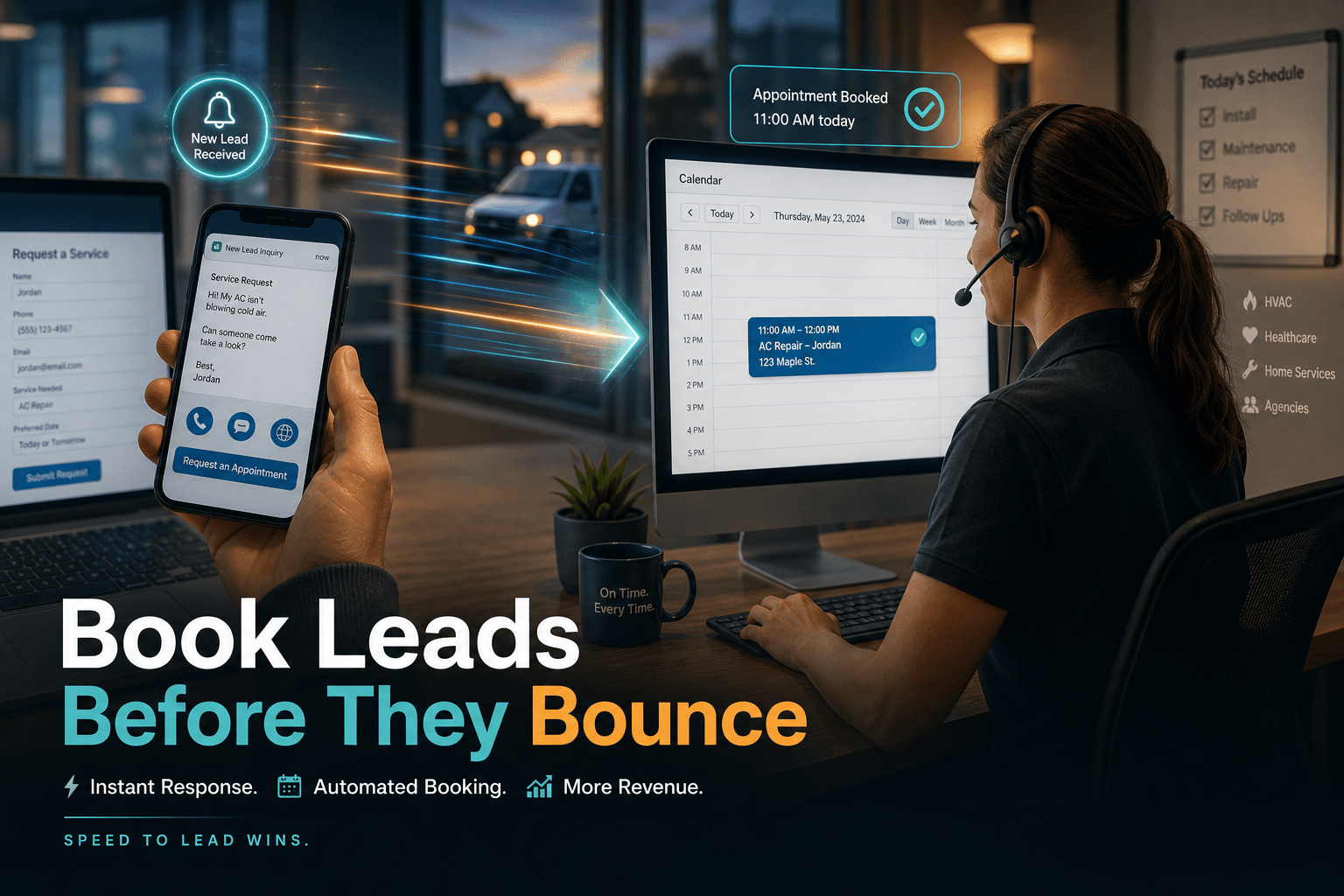
Appointment Booking Automation Boosts Speed-to-Lead
Most service businesses don’t have a lead problem. They have a booking gap.
A prospect fills out a form, calls after hours, or starts a chat while comparing three providers at once. Then the delay starts: voicemail, callback lag, calendar confusion, internal handoff, and the familiar “what time works for you?” loop. That’s where revenue slips. Recent CallRail data says 28% of inbound calls go unanswered, and over half of businesses miss at least 10 calls a month. For service businesses, those aren’t just missed conversations. They’re missed appointments, wasted ad spend, and jobs that go to someone faster. CallRail
The real cost of slow appointment booking for service businesses
Slow booking creates a chain reaction that hurts both revenue and operations.
First, there’s the obvious loss: a lead who doesn’t get on the calendar often never comes back. In local and service-based markets, intent is usually short-lived. A homeowner looking for an HVAC repair, a patient trying to book an opening, or a prospect comparing agencies is not waiting two days for scheduling emails. They’re moving to the next option.
Second, slow booking drags down marketing efficiency. If you’re paying for Google Ads, Local Services Ads, SEO, referrals, or outbound campaigns, every inquiry has an acquisition cost attached to it. When the handoff from inquiry to appointment is manual, that spend gets less efficient fast. We’ve found that teams often obsess over cost per lead while ignoring the more expensive issue: lead-to-appointment leakage.
Third, the delay affects show rates. The longer the gap between interest and confirmation, the weaker the commitment. That matters because no-shows create downstream pain: unused staff time, schedule holes, and awkward reshuffling. Acuity’s 2025 customer survey found that 80% of businesses acknowledge the emotional impact of no-shows, which tells you this is not just a calendar issue. It changes how the business runs day to day. Acuity Scheduling
In practice, slow scheduling usually shows up as:
- missed calls that never get returned
- form fills sitting in an inbox
- front-desk teams juggling callbacks manually
- reps sending booking links too late
- prospects dropping off during back-and-forth scheduling
That’s why appointment booking automation belongs in an operations conversation, not just a sales one.
What appointment booking automation actually does
Booking automation is not just a calendar link.
Done properly, it acts like a lightweight operating system between lead capture and service delivery. It takes the moment of intent and turns it into a confirmed next step with less human delay, less admin work, and fewer mistakes.
Instant response after form fills, calls, and chats
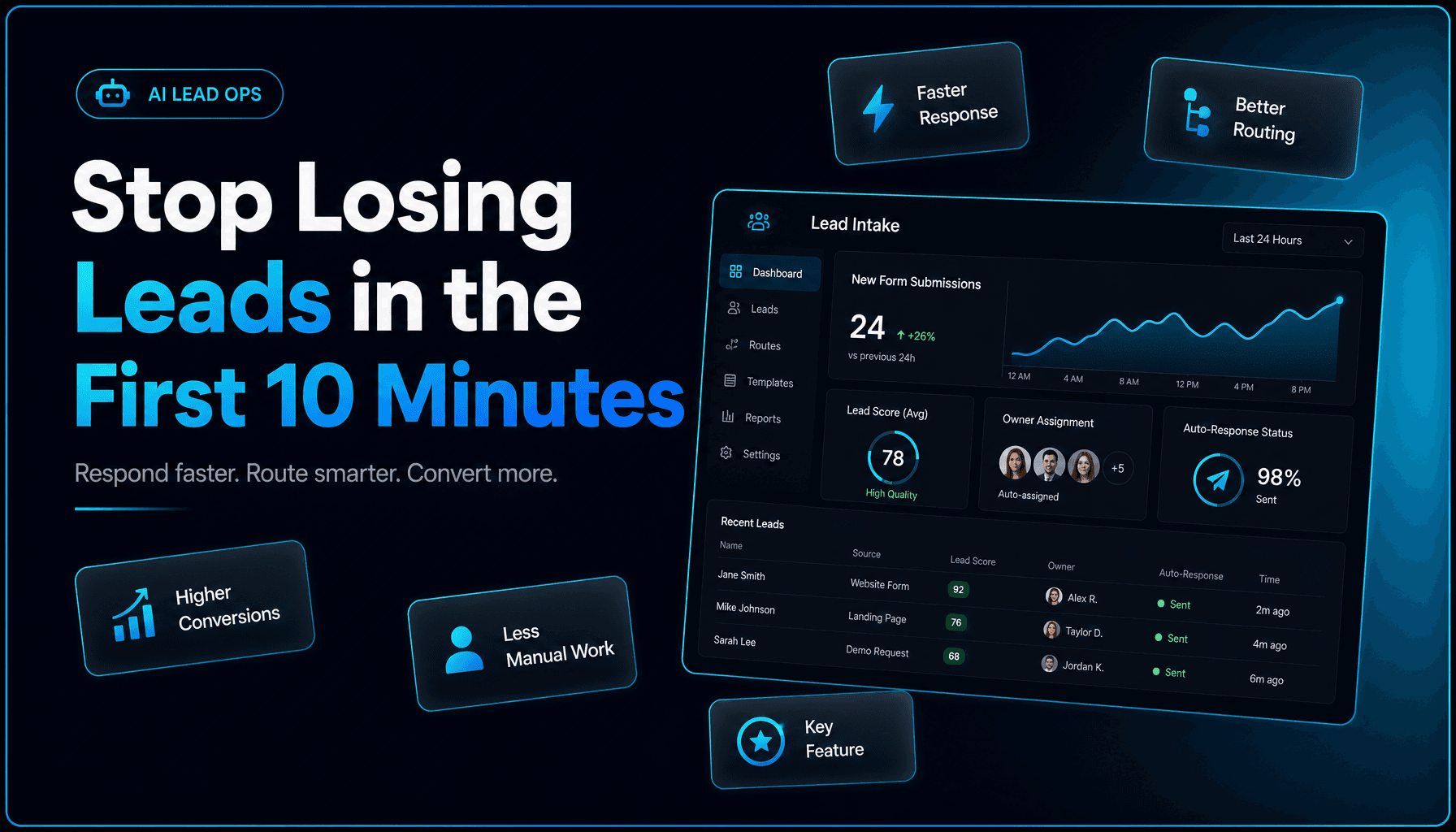
The first job is speed. When someone fills out a form, finishes a call, or starts a web chat, the system can immediately offer the right booking path instead of waiting for a human reply. That matters because interest is highest in the first few minutes, not the next business day.
This is where AI Automation and Workflow Automation start paying off. A lead doesn’t just get a generic thank-you email. They get a booking option tied to the service they asked about, the location they need, and the right next step.
Smart calendar routing and availability matching
Strong systems don’t dump every lead into one generic calendar. They route by rules:
- service type
- geography
- urgency
- staff skill set
- branch location
- team capacity
That’s especially useful for multi-location clinics, contractors with field territories, or agencies with different consultation types. Instead of a coordinator manually checking who’s free, the system matches the lead to live availability automatically.
Automated confirmations, reminders, and follow-ups
Once the appointment is booked, automation keeps it moving. Confirmation emails, SMS reminders, intake steps, rescheduling links, and post-booking follow-up all reduce drop-off without adding admin load.
This is one reason scheduling tools outperform manual processes operationally. In Acuity’s 2025 survey, 75% of businesses said automation reduced admin time overall, and 57% said they cut scheduling-related admin time by half or more. Acuity Scheduling
If you want the broader lead-response layer around this, our guide on 10 ways to use AI agents for inbound lead follow-up shows how booking fits into a faster inbound workflow.
Why speed-to-lead matters more in service businesses than in many other industries
In software or enterprise sales, a delayed meeting might slow pipeline progression. In service businesses, it often kills the opportunity entirely.
That’s because many service purchases are driven by one of three conditions:
- Urgency — plumbing, HVAC, legal help, med spa availability, urgent care, same-week consultations
- Comparison shopping — agencies, clinics, real estate, home services, coaching, salons
- Convenience — the provider that makes the next step easiest often wins
Fast booking becomes a competitive advantage because it signals competence. If your business can respond, route, and schedule immediately, the customer assumes delivery will also be organized. If they hit voicemail, wait for a callback, or have to trade emails to find a time, trust drops before the appointment even exists.
We’re also seeing this matter more outside normal hours. CallRail’s 2025 survey found that only 48% of home services businesses respond to after-hours inquiries immediately, meaning more than half are still exposed when intent comes in at night or on weekends. CallRail
For contractors, clinics, agencies, and local operators, that’s not a minor service issue. It’s market share moving to whoever is easier to book.
How automation shortens the path from interest to appointment
The biggest gain from automation is not magic. It’s subtraction.
It removes tiny delays that pile up between inquiry and confirmed appointment.
Eliminating back-and-forth scheduling
Manual scheduling creates friction in places teams stop noticing:
- “Are you free Thursday?”
- “No, what about Friday?”
- “Morning or afternoon?”
- “Can you do the downtown office instead?”
Self-booking collapses that into one action. The prospect sees real availability and picks a time. No phone tag. No inbox loop. No waiting for a rep who’s already in meetings.
Preventing lead leakage outside business hours
A large share of service intent happens when the team is unavailable. Nights, weekends, lunch rush, field visits, and appointment blocks all create gaps. Automation keeps the booking path open 24/7, which is especially valuable when leads come from paid channels.
CallRail reports that agencies using its Voice Assist beta saw a 40% increase in total answered calls, turning previously missed conversations into captured opportunities. CallRail
Reducing human delay in handoffs
A lot of speed-to-lead problems are really handoff problems. The lead came in, but nobody knew who owned it. Or the front desk took a note but didn’t route it. Or sales had to check a specialist’s calendar manually.
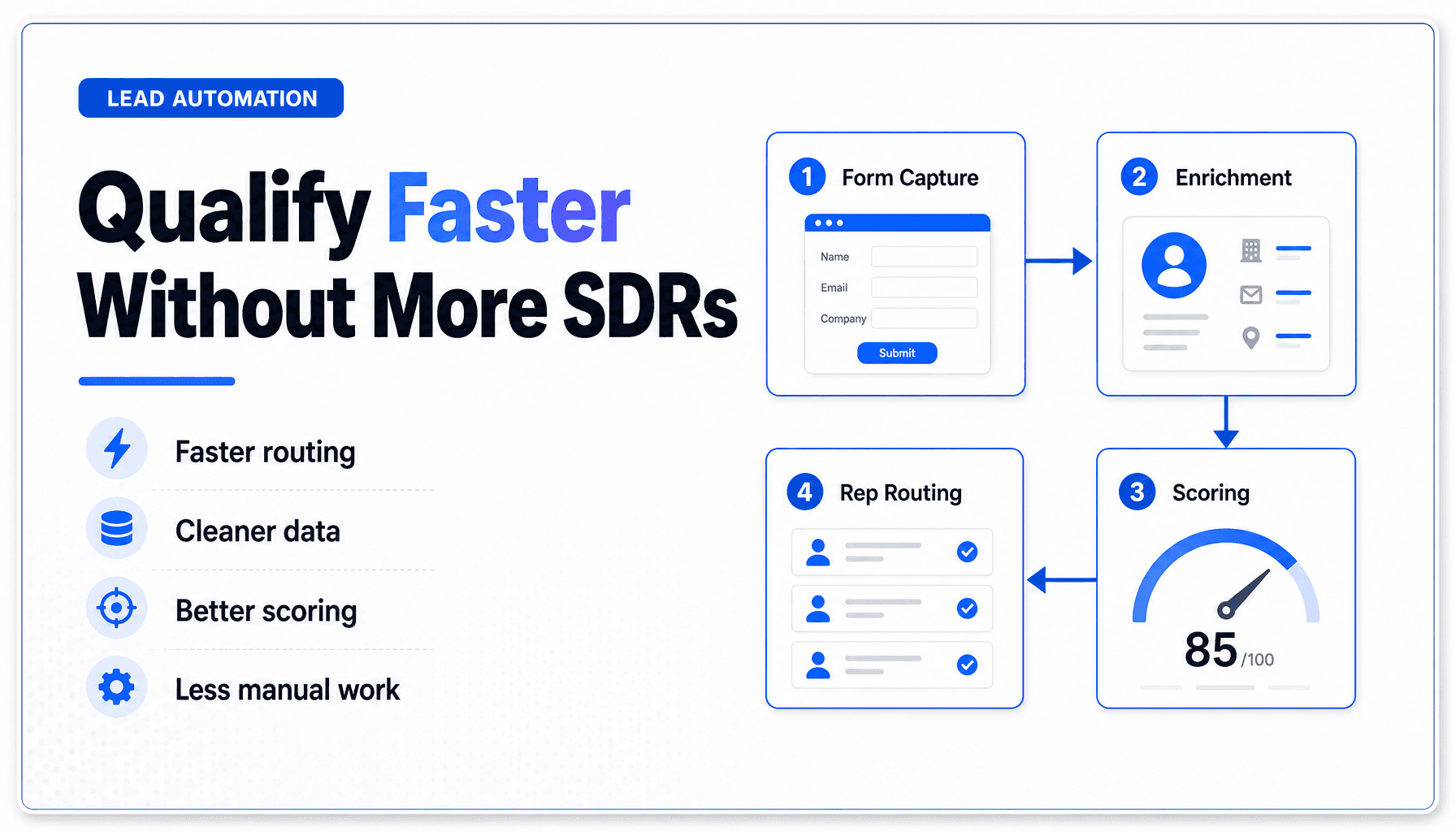
A better flow looks like this:
Form / call / chat
→ qualification rules
→ correct calendar or team
→ booked appointment
→ confirmation + reminder
→ CRM update + internal alert
That’s where CRM Automation, AI Agents, and Multi-agent Systems become useful. Not because they sound advanced, but because they remove the operational lag between systems.
The customer experience benefits of instant booking
Speed matters, but the customer experience payoff is just as important.
A fast, clean booking flow reduces uncertainty. The prospect knows you received the inquiry, sees available options, gets confirmation right away, and can reschedule without friction if needed. That creates confidence before your team ever delivers the service.
This is one of the more underrated benefits of automation. In Acuity’s 2025 survey, 67% of businesses said scheduling improved professionalism, and 65% said their branded scheduling page made them feel more professional. Acuity Scheduling
That sounds cosmetic until you’ve worked with service businesses where reputation depends on small signals. A clean booking flow tells the customer:
- this business is organized
- they respect my time
- I won’t have to chase them
- they’re likely to handle the actual service well too
There’s also a self-service angle. HubSpot’s 2024 State of Service report found that customers increasingly expect fast resolution and prefer self-service options in many interactions. HubSpot
For service businesses, booking is often the first real test of that expectation.
Common appointment booking bottlenecks automation solves
Most teams don’t need more leads first. They need fewer operational leaks.
The common bottlenecks are predictable:
- missed inbound calls
- slow response to web forms
- double bookings or stale availability
- generic follow-up that doesn’t move to a calendar
- manual reminders and reschedules
- overloaded front-desk or admin staff
The mildly contrarian point: automation does not fix a messy service model by itself. If your routing rules are wrong, your calendars are inaccurate, or your service categories are too vague, you can automate confusion at scale. Harvard Business School highlighted this broader problem in 2025: when input data is flawed, automated schedules and recommendations become unreliable fast. Harvard Business School Working Knowledge
What actually works is pairing automation with good operational structure:
- clear service types
- accurate staff availability
- defined routing rules
- consistent CRM stages
- fallback paths for edge cases
If you’re already cleaning up lead records and handoffs, our piece on 7 ways to optimize your CRM with AI automation is a useful companion.
Best practices for implementing booking automation without hurting the customer experience
The goal is faster booking, not colder booking.
Keep the booking flow simple
Every extra field costs conversions. Ask for what you need now, not everything you might want later.
A good default for service businesses is:
- name
- contact info
- service needed
- preferred location or area
- one qualifying field if truly necessary
If the form looks like intake paperwork before trust is built, completion drops.
Use routing rules that match business priorities
Route by what matters operationally:
- service type
- geography
- urgency
- job value
- team capacity
This is where Lead qualification logic should live. Not every appointment deserves the same path. A high-value consultation, emergency job, or premium service request may need a faster or more senior handoff.
Combine automation with human touchpoints where it matters
Some bookings should stay automated end to end. Others convert better with a human step.
We’ve found human follow-up still matters most when:
- the service is high-ticket
- the case is complex
- urgency is emotional or sensitive
- the lead is comparing multiple providers closely
That’s where Voice AI or live outreach can complement automation rather than replace it.
Metrics to track after automating appointment booking
If the system is working, the numbers should move quickly.
Track:
- time to first response
- lead-to-appointment booking rate
- after-hours booking rate
- no-show rate
- reschedule rate
- appointment-to-sale conversion rate
- admin time spent on scheduling
- missed-call rate
The most important shift is usually this one: how many inquiries become confirmed appointments without manual chasing.
How to know if your business is ready for appointment booking automation
You’re probably ready if any of these sound familiar:
- you get steady inquiry volume but bookings lag behind
- staff are answering the same scheduling questions all day
- calls go unanswered during busy periods
- leads arrive after hours and sit until morning
- reps or coordinators manually check calendars
- no-shows create expensive gaps
- your front desk is overloaded
- marketing is generating leads faster than ops can schedule them
If that’s your situation, appointment automation is not a nice-to-have. It’s an operational fix tied directly to revenue capture.
Final takeaway: faster booking is faster revenue
Appointment booking automation works because it solves the problem between demand generation and service delivery.
It removes scheduling friction, captures intent while it’s still fresh, routes leads to the right person or calendar, and keeps appointments moving with reminders and follow-up. For service businesses, that means better speed-to-lead, fewer missed opportunities, less admin work, and a smoother customer experience from the first interaction.
The important shift is to stop treating scheduling as back-office admin. It’s part of conversion. It’s part of operations. And in many businesses, it’s the difference between paying for leads and actually turning them into revenue.
If your team is losing time in handoffs, missed calls, or manual scheduling, AI-Automated can help you build booking workflows that connect forms, calls, calendars, and CRM follow-up into one practical system. If you want a faster path from inquiry to appointment, book a consultation and we’ll map the bottlenecks with you.