Why Small Businesses Should Treat AI Agents Like Digital Employees
Most small businesses have already “tried AI.” Someone drafts emails in ChatGPT. A chatbot sits on the website. And at least one person on the team has a favorite agent that can, in theory, do a little of everything.
That last one is usually the problem.
A small business does not need an AI agent that can do anything. That is how it ends up doing the wrong thing in five different places: a polite reply that books the wrong time, a CRM note that creates a duplicate, a follow-up that goes out after a rep already called.
The better model is almost boring. Treat AI agents like digital employees. Give them a narrow job, limited access, a way to measure the work, and a person who notices when it goes sideways.
That is still where most teams stall. Business.com’s 2026 Small Business AI Outlook found 84% of SMB workers used chatbots in the past year, but only 19% used workflow automation tools. Chat is easy. Assigning a real job is the part that pays off.
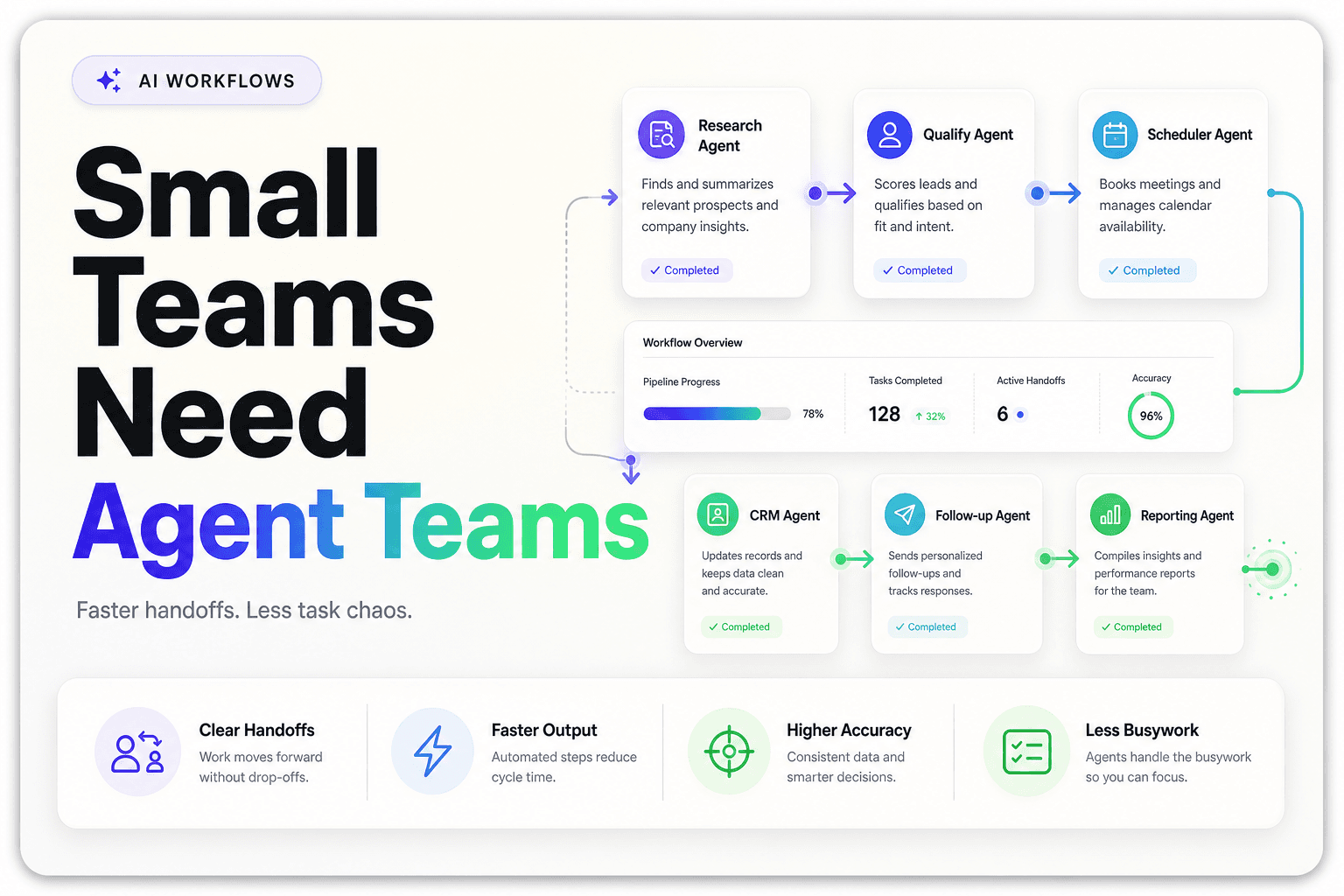
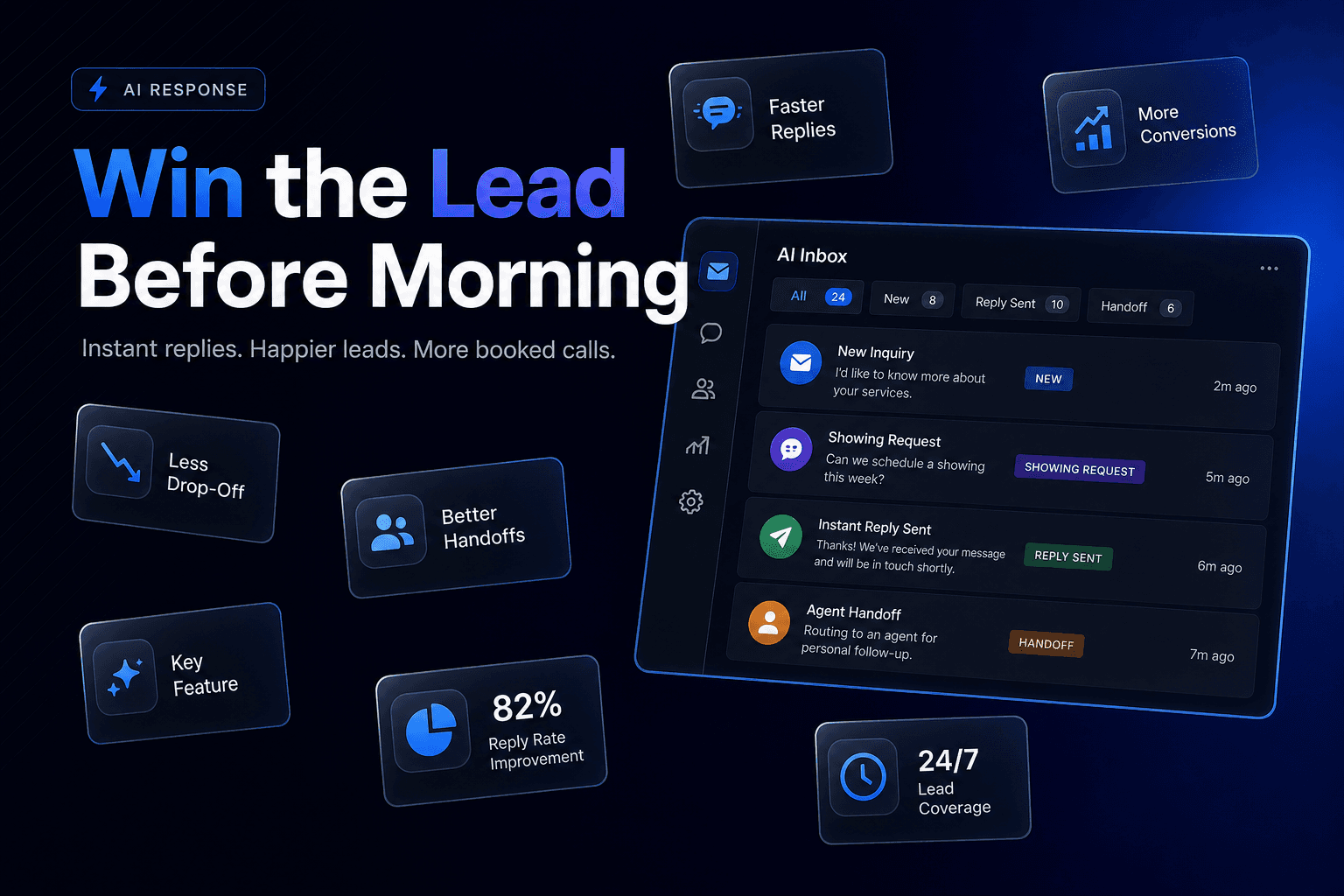
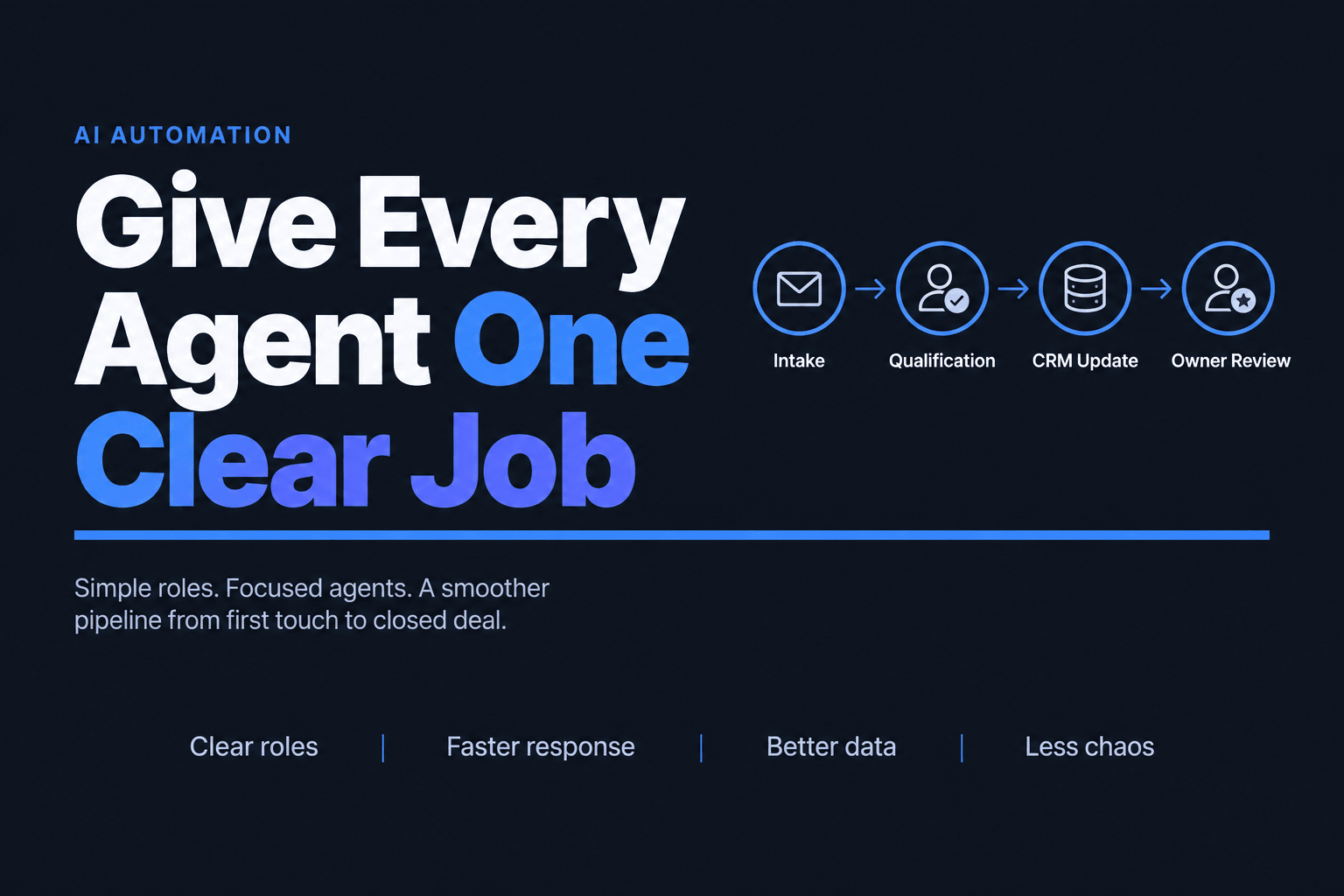
For a lean team, that might mean an intake agent that replies in two minutes, a qualification agent that checks fit, and a CRM agent that turns the conversation into clean pipeline data. Each one has one job. Each one can be fired, retrained, or promoted without blowing up the rest of the operation.
Stop hiring a “generalist” bot for five different jobs
Imagine a new lead arrives at 8:42 p.m. They want a kitchen remodel, live 40 miles outside your service area, have a modest budget, and ask for a call tomorrow.
A generic bot may write a pleasant reply. Great. It may also create a duplicate contact, promise a time your estimator cannot make, and skip the service-area check. Less great.
The better setup uses role-based agents:
- Intake agent: Pulls name, location, service requested, timeline, and contact preference.
- Qualification agent: Checks service area, job type, budget thresholds, duplicate records, and urgency.
- Routing agent: Sends qualified opportunities to the right rep or nurture track.
- CRM agent: Creates or updates the record with standardized fields and a readable activity note.
- Follow-up agent: Sends the approved next message and pings a human when a lead needs attention.
That split sounds fussy until something breaks. Then it sounds like common sense.
Specialized agents are also easier to debug. If an appointment was booked incorrectly, you inspect the scheduling rules. If a lead was scored badly, you inspect the qualification criteria. With one all-purpose bot, every failure becomes a scavenger hunt through prompts, tools, and freeform notes.
This is also why small teams should think past a single chat window. A customer-facing assistant can help, but it is only one piece of the operation. Our guide to multi-agent systems for small business operations shows how distinct agents can coordinate lead capture, CRM updates, follow-up, and handoffs without turning the process into an unreadable tangle.
Give every agent a job description that fits on one screen
Human employees need a job description before their first day. Digital employees need one before their first API call.
Keep it painfully specific. “Help with leads” is not a role. “Review inbound demo forms, assign an ICP-fit score from 0 to 100, fill the required CRM fields, and route scores above 70 to the sales queue” is a role.
A practical agent brief should answer five questions:
- What event starts the work?
- What information can the agent read?
- What decision is it allowed to make?
- What action can it take?
- When must it escalate to a person?
A real estate team might assign an agent to read Zillow inquiries, identify whether the person is buying, selling, renting, or browsing, and trigger a response in under five minutes. It should not decide mortgage eligibility, negotiate an offer, or send a listing without approved inventory.
Access should follow the job. If the agent is not responsible for refunds, it should not be able to issue them.
An agent that can update every CRM field, send every email, and book every calendar is not efficient. It is over-permissioned.
The role should also include a definition of done. A lead-intake agent is finished only when required fields are captured, the CRM record is created or matched, the lead owner is assigned, and the prospect gets the correct next step. A polished summary is not the job.
For teams building lead workflows, an AI lead qualification score sales will actually trust starts with the same discipline: define the signals, show the reasoning, and make sure reps can challenge bad calls.
Permission boundaries matter more than clever prompts
Prompt quality still matters. Permission design matters when money, customer trust, or data is on the line.
An agent can be excellent at summarizing a customer call and still have no business issuing a refund. It can spot a high-intent lead without being allowed to move that prospect to closed-won. It can draft a late-payment reminder without automatically emailing a long-time client whose account already has a billing dispute.
Use four levels of authority:
| Authority level | Agent behavior | Example | | --- | --- | --- | | Read | Retrieves and summarizes information | Pulls past tickets before a support reply | | Recommend | Suggests an action for approval | Proposes a lead score or routing decision | | Act within rules | Takes approved actions under set conditions | Creates a CRM record when email and phone are present | | Escalate | Stops and alerts a person | Flags refund requests above $250 |
Agents tend to get risky long before they get impressive. Deloitte’s 2026 State of AI in the Enterprise found that only 21% of surveyed organizations had mature governance for agentic AI. Roughly 80% still lacked basics like decision boundaries, monitoring, and audit trails. In May 2026, Gartner predicted that by 2027, 40% of enterprises will demote or decommission autonomous agents because those gaps only showed up after something broke in production.
Small businesses do not need a committee with twelve acronyms. They do need a record of what the agent saw, what it decided, what tool it used, and what it changed.
In practice, start agents in draft-only or approval-required mode for the first 30 days. Let the system earn more autonomy through consistent performance. A sales agent can research, score, and draft follow-up all day. A person approves the first batch. Once the error rate stays low, expand what it is allowed to do on its own.
If you cannot score the work, do not automate it yet
“Saved time” is a useful feeling. It is a lousy operating metric.
Business.com’s 2026 survey found the average small business worker saves 5.6 hours a week with AI, and managers save 7.2. That sounds like a win until you ask what those hours were spent on. If the agent is sending more follow-ups to poor-fit leads, or creating CRM records nobody uses, you did not buy productivity. You bought faster mess.
Every digital employee needs a scorecard tied to the job it owns. Match the metric to the role:
Lead qualification agent
- Median first-response time
- Qualified-lead rate
- Sales acceptance rate
- False-positive rate

CRM update agent
- Required-field completion rate
- Duplicate-record rate
- Manual correction minutes per week

Appointment agent
- Booking completion rate
- Reschedule resolution time
- No-show rate by reminder path
Pick a baseline before launch. If a coordinator currently spends six hours each week cleaning notes and the agent reduces that to 90 minutes while keeping 95% field accuracy, you have a result worth discussing. If it saves four hours but creates 18 bad assignments a month, you have a problem wearing a productivity hat.
The lesson is not “add more tools.” It is to measure whether the connected tools improve the full job, rather than speeding up one isolated step.
Your agent team will create messes if handoffs are vague
Most agent failures are boring. A lead reaches sales without a phone number. A qualification agent flags “enterprise” because it saw a large number on a prospect’s website that was actually the year the company was founded. A follow-up agent sends an email after a rep has already started a personal conversation.
These are handoff problems.
A clean agent workflow needs a shared source of truth and explicit stop conditions. The intake agent should write structured fields, not bury key details inside a paragraph. The qualification agent should know when a record is incomplete. The routing agent should check whether a human has already claimed the lead before it sends another notification.
This is where CRM automation earns its keep. Build the handoff around fields your team already uses:
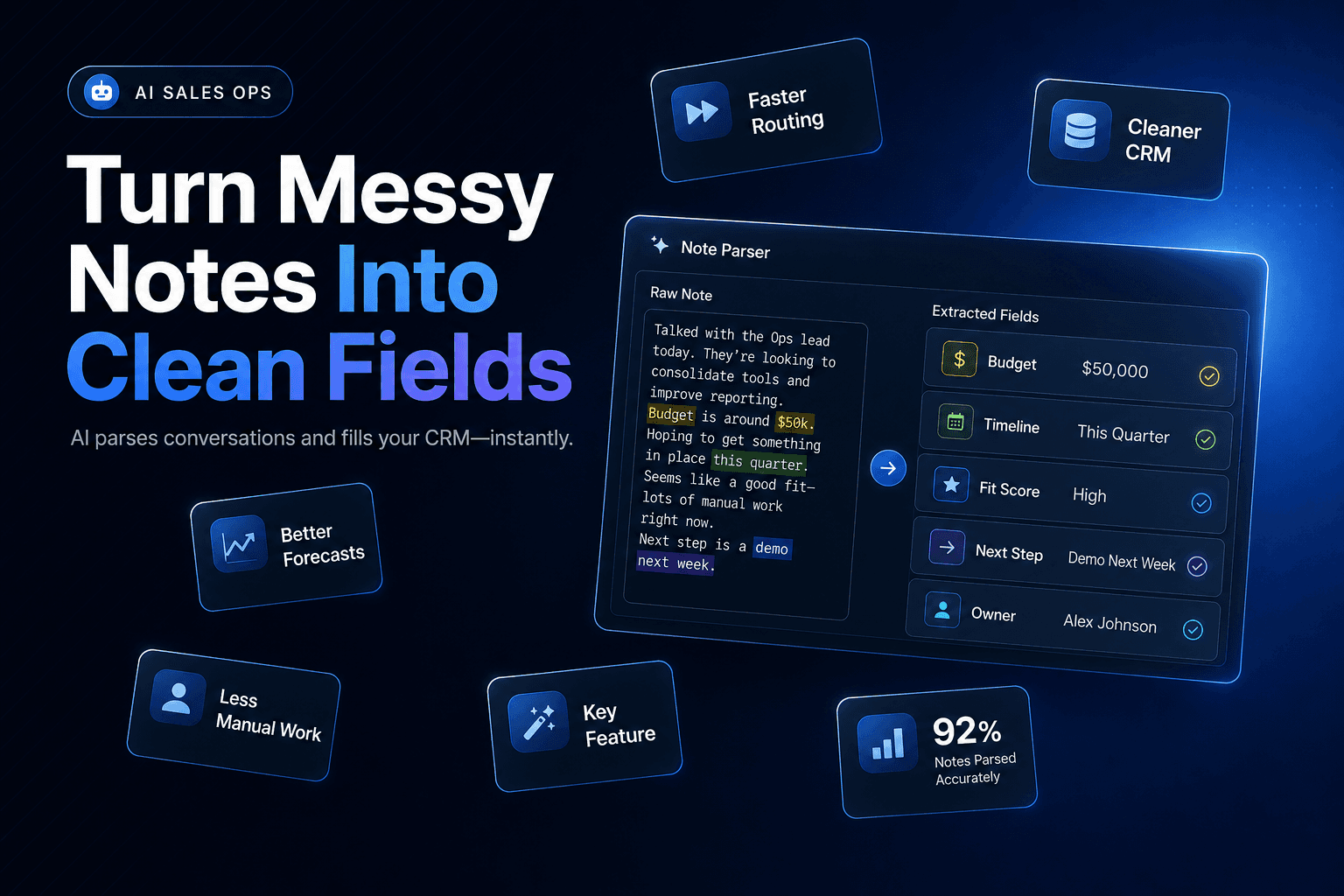
lead_sourceservice_requestedservice_area_matchestimated_valuequalification_confidenceassigned_ownernext_action_due
Freeform notes still have a place. Salespeople need context. Operations needs fields.
Full autonomy is not a prize for its own sake. If an agent cannot hand work off cleanly, giving it more freedom just lets it fail faster. For lead operations, a structured intake process makes the handoff visible and fixable. See how to build an AI lead intake system that routes, scores, and responds automatically for the practical flow behind it.
Treat the first agent like a probationary hire
The best first AI agent is rarely the flashiest one. It is the role with a repeatable trigger, a clear finish line, accessible data, and a frustrating amount of manual coordination.
Start with one job: qualify web leads, turn call notes into CRM fields, chase missing intake details, or compile a daily exceptions report. Give it a written role, limited permissions, an escalation path, and a scorecard. Review its work every week for the first month.
Then decide whether it deserves a bigger job.
That is how small businesses get real value from agents without adding another dashboard nobody checks. At AI-Automated, we build practical systems that handle lead qualification, CRM updates, coordination work, and customer handoffs with the rules your team already needs. If repetitive work is slowing down your response time or clogging your pipeline, schedule a free consultation and let’s design the first digital employee around a job that actually matters.