
Why Voice AI Is Becoming the First Layer of Customer Communication
Most businesses still treat phone, chat, SMS, forms, and email as separate inboxes. Customers do not. They just want the fastest path to an answer. That is why Voice AI is becoming the first layer of customer communication: not because every customer wants to talk to a bot, but because the first response now has to be immediate, available, and able to move work forward.
That shift is showing up in the data. In Verint’s State of Customer Experience 2026 report, 79% of consumers said they would switch after one bad experience, and 69% said they would use automation if it fully resolved the issue. In other words, the real standard is not “human first.” It is resolution first.
The first touchpoint is no longer a receptionist, it is a routing system
When we look at how small businesses actually lose revenue, the problem usually is not the sales call that went badly. It is the lead that never got answered, the service request that sat in voicemail, or the caller who needed a simple update and gave up.
That makes the first layer of communication operational, not just conversational.
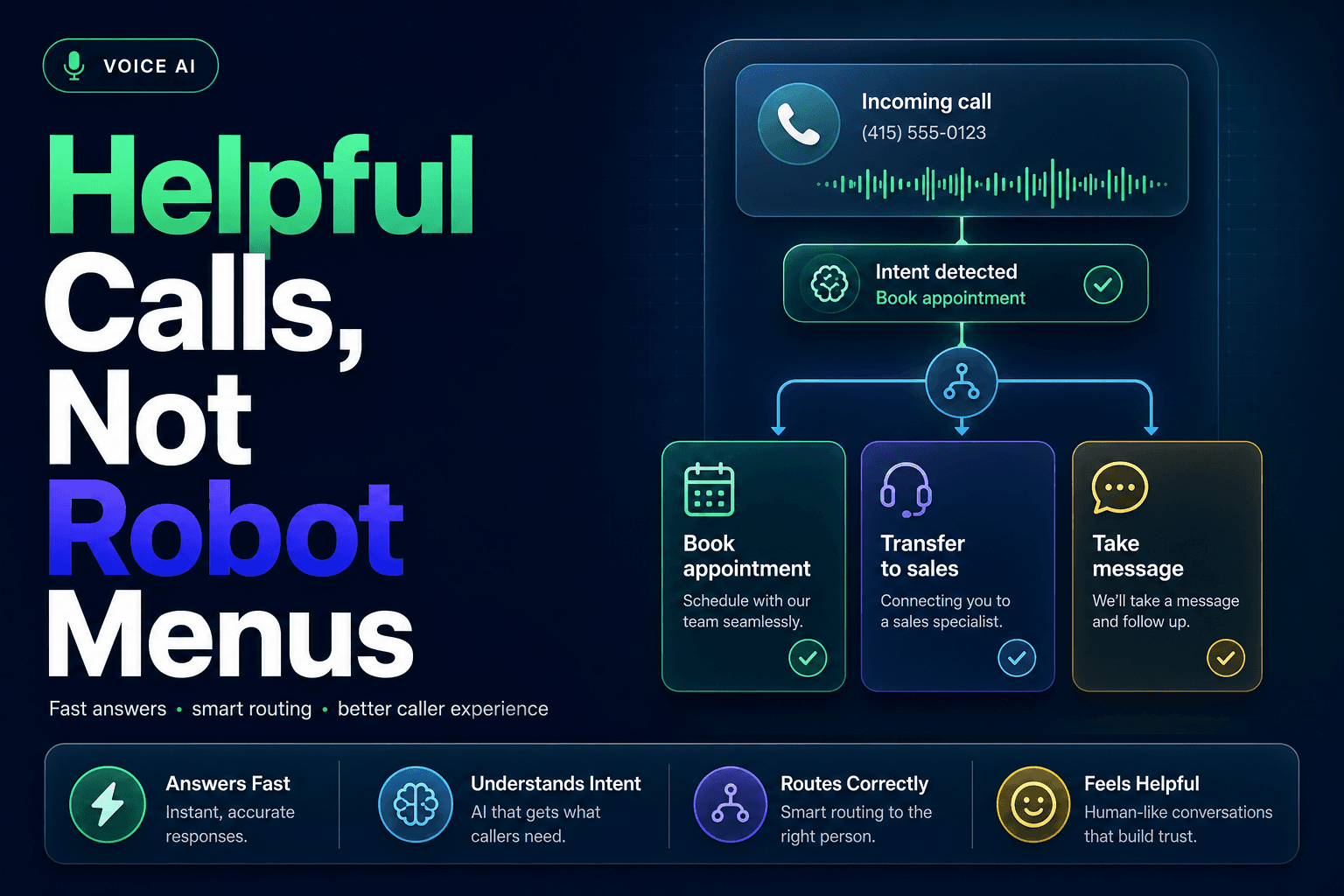
A good Voice AI front layer can:
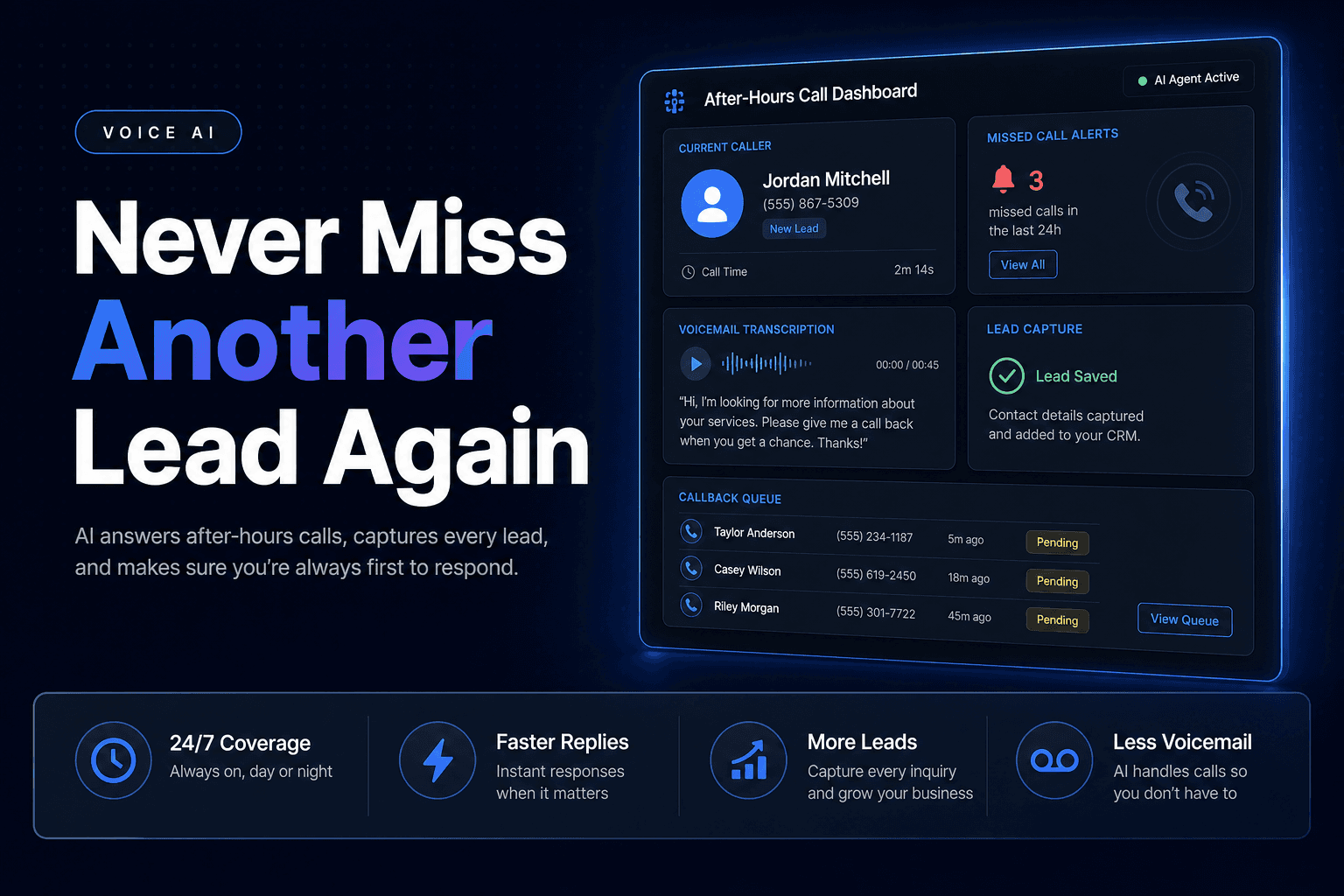
- answer after-hours calls
- capture intent in plain language
- qualify urgency or fit
- route to the right person or workflow
- trigger follow-up in the CRM
- hand off edge cases to a human with context attached
This is why voice is moving ahead of older menu trees and static voicemail. The first interaction is no longer just about greeting someone politely. It is about reducing delay.
In practice, this matters most for businesses where response time changes outcomes: real estate teams, service businesses, clinics, agencies, law firms, and any company with uneven front-desk coverage. If your team is already working on CRM Automation and faster handoff, voice becomes the intake layer that feeds the rest of the system. That is the same logic behind Why Speed to Lead Still Wins in 2026 and How AI Helps You Get There and How to Build an AI Lead Intake System That Routes, Scores, and Responds Automatically.
Customers care less about the channel than whether it gets them unstuck
A lot of AI coverage still frames this as a format debate: voice versus chat, automation versus human support. That is too simplistic.
What actually happens is that customers pick the path that feels easiest in the moment. If they are driving, they call. If they are at work, they may text. If they have a billing issue, they want the shortest route to resolution and do not care much how it happens as long as they do not have to repeat themselves.
That is why voice is becoming the first layer. It can do something chat often cannot do as quickly: gather nuance fast. A caller can explain urgency, location, frustration, and intent in 20 seconds. A form usually cannot.
The economics have changed too. In the Coval Voice AI 2026 report, production deployments were described as reaching 75% to 85% resolution rates when the experience is well designed. That does not mean every business should automate every call. It means voice is no longer reserved only for expensive human-only handling.
For customer-facing teams, that changes design priorities:
- Put Voice AI at the front.
- Resolve simple requests immediately.
- Route medium-complexity issues with captured context.
- Escalate sensitive or high-value conversations to humans.
That stack works better than making every caller start with voicemail or making every lead fill out a form.
Do not mistake “first layer” for “replace the human”
This is where teams get overconfident.
A first layer is not the whole customer experience. It is the triage, intake, and momentum layer. The moment a company treats Voice AI like a total replacement for people, quality usually drops.
There is plenty of evidence that customers still want a human option. In the ACSI 2026 AI survey, 43% of respondents said loss of human-to-human interaction was their top concern about AI. That number matters because it explains why some AI phone experiences feel efficient in demos but frustrating in production.
The contrarian truth is simple: the problem is rarely that the voice sounds artificial. The problem is that the system cannot actually help.
Common failure points look like this:
- it answers fast but cannot access scheduling or CRM data
- it captures details but never triggers follow-up
- it has no clean human handoff path
- it sounds polished but asks too many repetitive questions
- it routes based on keywords instead of business rules
If you want voice to become the first layer successfully, design for handoff quality, not just containment rate. We have found that a short, accurate transfer summary often matters more than squeezing every possible call through automation.
That is also why businesses exploring service automation should connect voice to broader workflows, not treat it as a standalone gimmick. How to Automate Customer Inquiries: A Step-by-Step Guide for Modern Businesses and How AI Agents Are Revolutionizing Customer Service for Small Businesses and Solopreneurs both point in that direction.
The winners are building voice into workflows, not bolting it onto the phone line
The biggest shift in 2026 is not that AI can answer calls. It is that it can do something useful after the answer.
That is the difference between old call automation and modern AI Agents.
A practical voice workflow might look like this:
- A missed inbound call is answered by Voice AI.
- The caller explains they need to reschedule, get pricing, or check availability.
- The agent identifies intent and urgency.
- It updates the CRM, books a slot, sends a confirmation text, or routes to the correct team.
- A human steps in only if the request is high-stakes or unusual.
That is not just voice. That is Workflow Automation.
For lead-driven businesses, this is especially valuable. A voice layer can pre-qualify budget, timeline, location, and service type before a rep ever joins the conversation. That is a much better use of staff time than having someone spend half the day listening to voicemail and manually copying notes into a CRM. If lead ops is your bottleneck, 9 Tools for Automating Lead Qualification Without Adding SDR Headcount and How to Automatically Research Leads Using AI Agents show how the rest of that pipeline should connect.
What matters is orchestration. Voice alone does not create value. Voice plus routing, qualification, and system actions does.
If you wait for perfect AI, you will miss the real use case
A lot of teams delay adoption because they imagine the bar is “indistinguishable from a human.” That is the wrong benchmark.
The real benchmark is much simpler:
- Did the customer get an answer quickly?
- Was the request classified correctly?
- Did the next step happen automatically?
- Could a human step in without starting from zero?
That is why businesses are moving faster than the old skepticism suggests. In a 2025 SoundHound consumer study, 71% of respondents said they would choose a company offering AI agent customer service over one that did not, and the share who were very satisfied rose from 26% to 57% after experiencing the AI interaction.
Those numbers should not be read as “everyone wants bots.” They should be read as “good automation is now competitive.” That is a different claim, and a more useful one.
For small businesses, the first wins are usually narrow:
- after-hours call coverage
- appointment intake
- FAQ deflection
- lead qualification
- overflow call handling
- basic status updates
If you start there, voice becomes a practical front door. If you start by trying to automate every edge case, it usually falls apart.
The first layer of customer communication is becoming programmable
This is the deeper change underneath the trend. The first layer used to be fixed: a receptionist, a phone tree, a shared inbox, a voicemail box. Now it is programmable.
That means businesses can shape first contact around actual business goals:
- qualify leads before reps touch them
- reduce missed calls without hiring more front-desk staff
- book appointments directly from inbound conversations
- standardize intake across locations or teams
- capture structured data from every conversation
Once that layer is programmable, it becomes a business system, not just a communications tool.
This is where Multi-agent Systems, Voice AI, and AI Automation start to converge. One agent handles the conversation. Another updates the CRM. Another checks availability. Another drafts the follow-up. The customer experiences one smooth exchange, but under the hood the workflow is doing real operational work.
That is why voice is increasingly the first layer. It sits at the top of the funnel, catches demand in real time, and pushes clean data into the rest of the operation. For businesses that live or die on responsiveness, that is a serious advantage.
The companies that benefit most will not be the ones with the flashiest demo voice. They will be the ones that make the first interaction useful.
If you want to build a Voice AI system that answers, qualifies, routes, and follows up without adding headcount, AI-Automated can help. We design practical AI Agents and Workflow Automation systems that turn first contact into a working part of your sales and service operation.